What’s small, screen-free, and is amazing for both spatial awareness and working memory? The game my husband calls “card Tetris”: Silver and Gold! If your family likes a bit of logic, treasure, and math, too, then I think you’ll enjoy it.
This post may contain affiliate links, meaning if you click on it and make a purchase, I’ll receive a small commission at no cost to you. As an Amazon Associate, I earn from qualifying purchases. For more information, please check our Privacy Policy and Disclaimers and Disclosures.
Silver and Gold Game Components
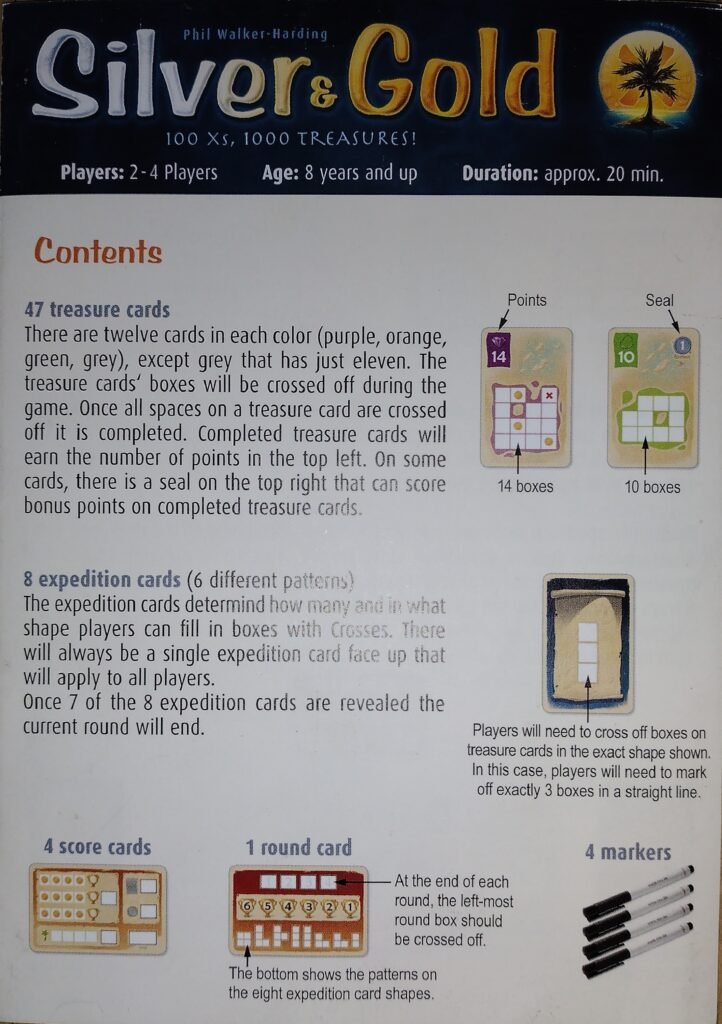
This very small game is composed of 60 cards, a “dealer” token to be used as a first player token (I don’t know why; we thought maybe the tokens with “dealer” on them were cheaper), and 4 dry-erase markers. The cards are
- 1 round card
- 4 score cards
- 8 expedition cards
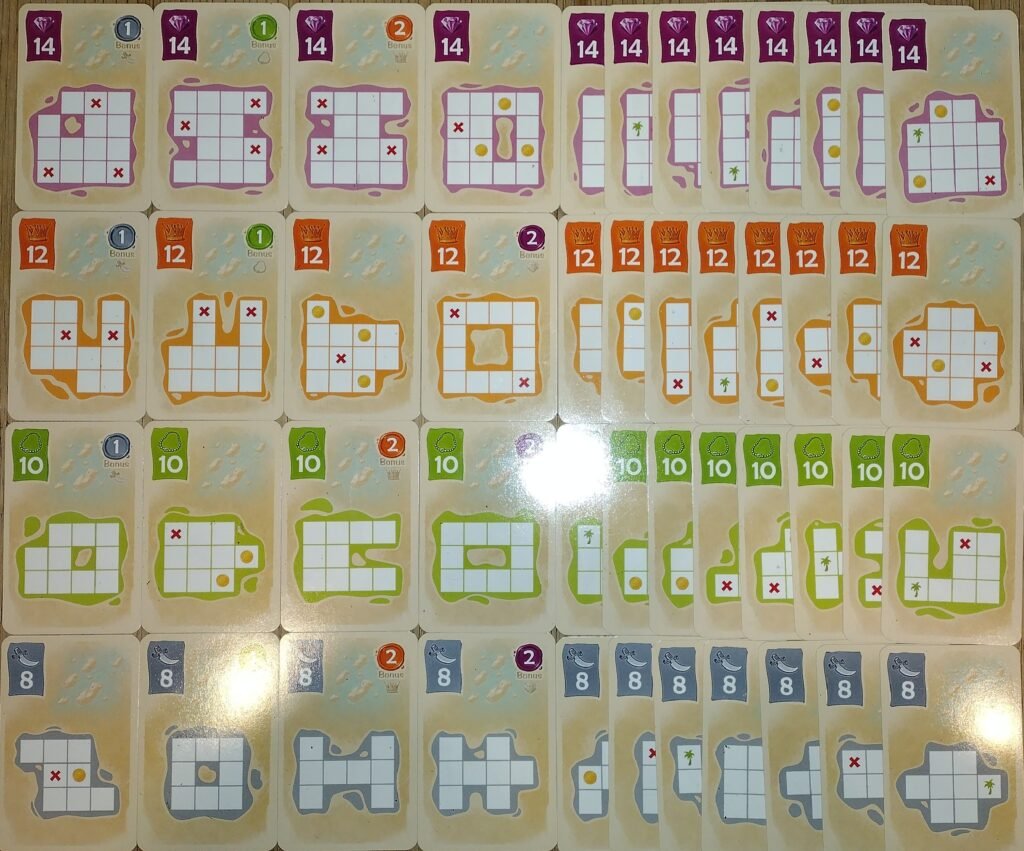
- And 47 treasure cards
Treasure cards
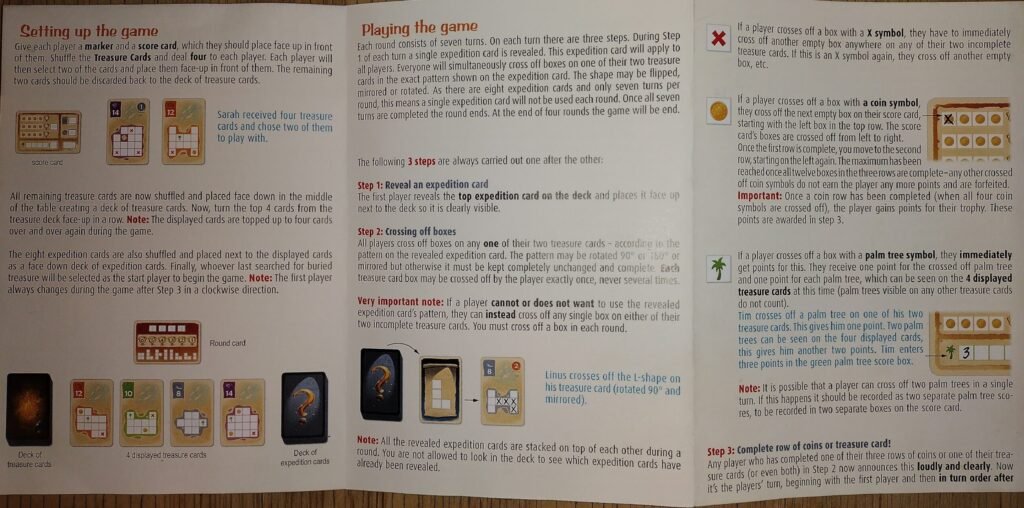
Silver and Gold is played over 4 rounds of 7 turns each. To begin, each player gets a score card, a dry-erase marker, and 4 treasure cards, of which they choose 2. Four treasure cards are placed face-up on the table, and the rest of the treasure cards are in a deck.
Expedition cards
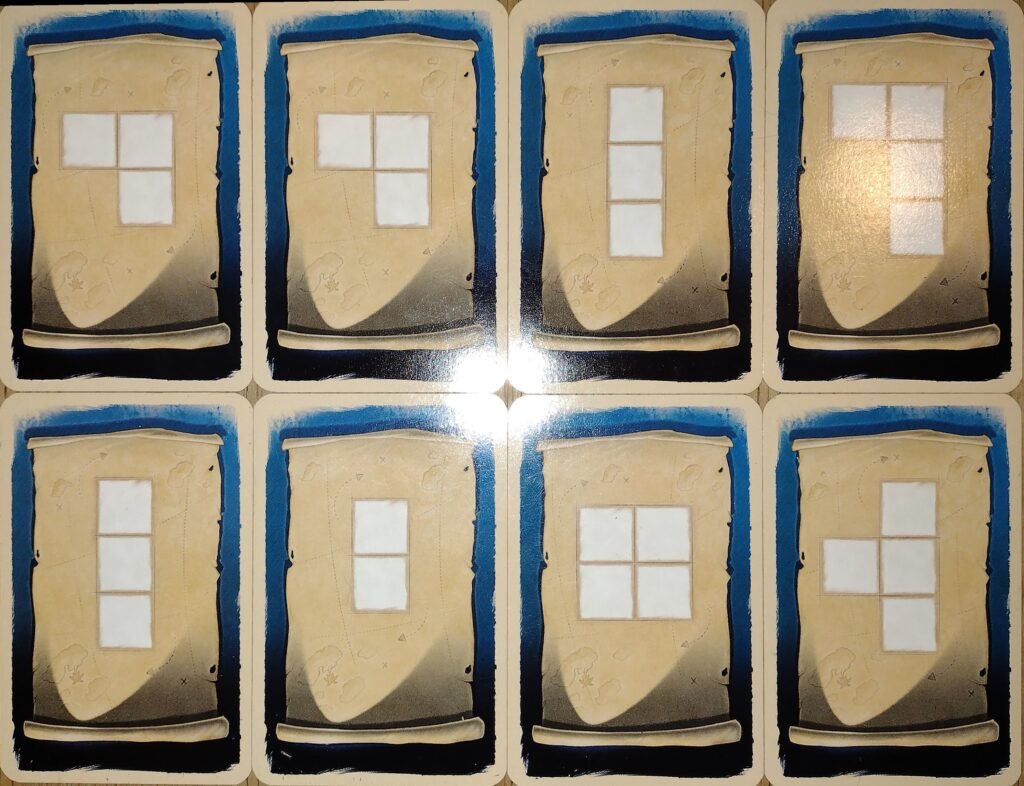
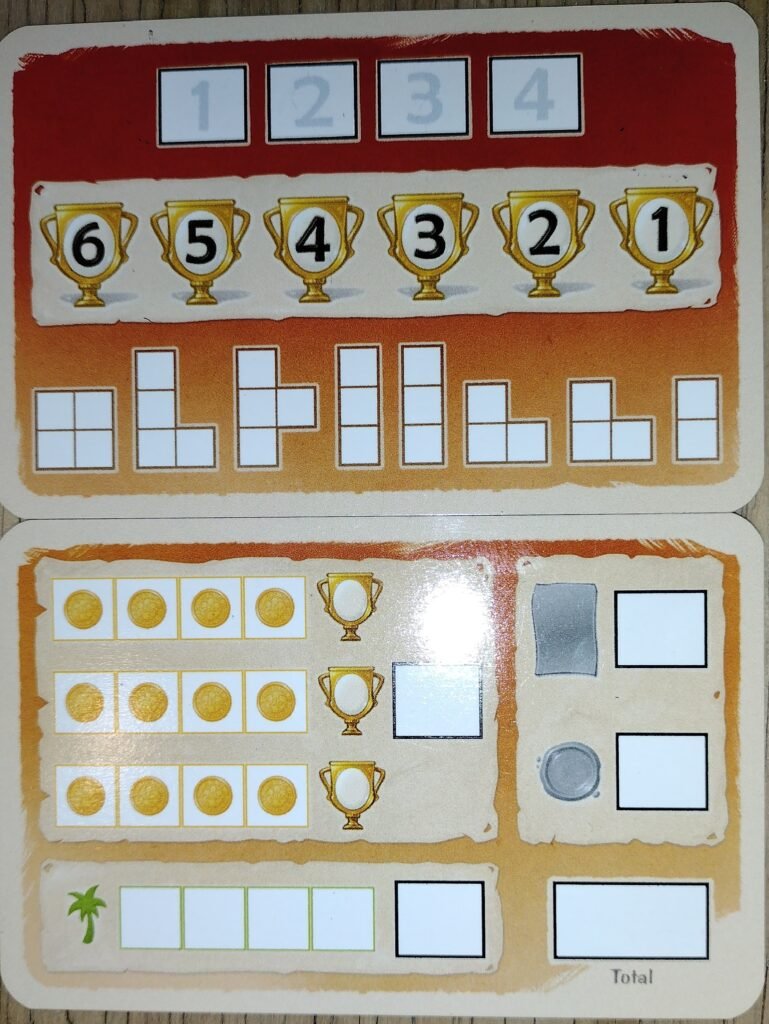
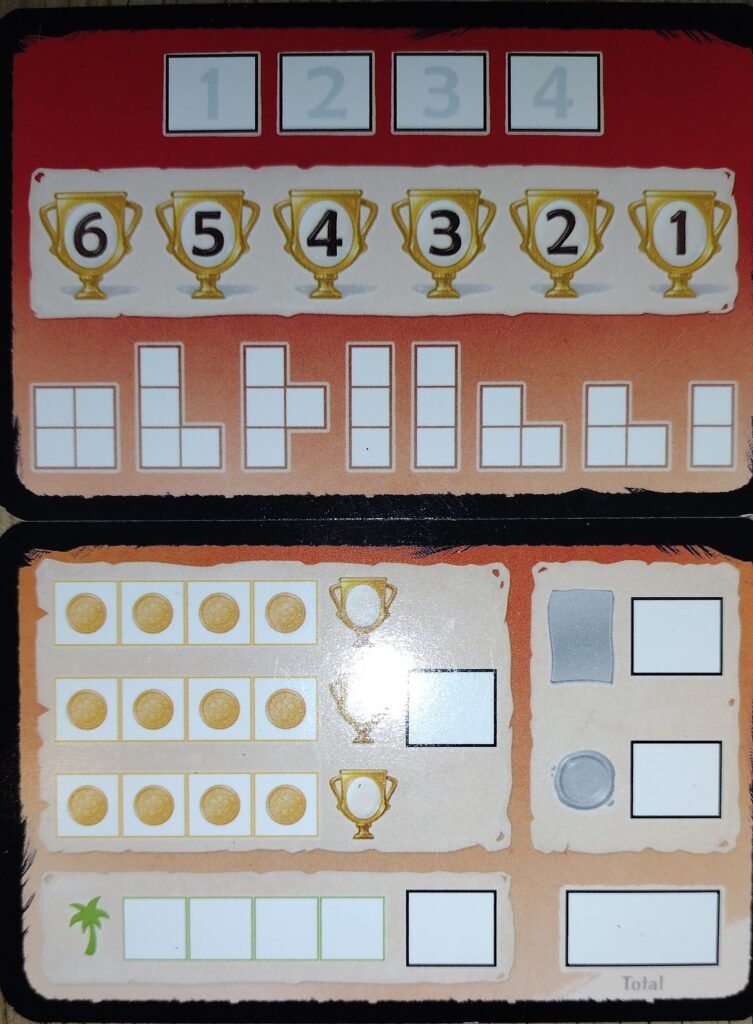
The round and score cards are double-sided, but I haven’t noticed a difference between the sides.
The treasure cards each have a shape on them and the points they’re worth in a corner. Some have a circle in another corner that indicates bonus points. Some of the squares might have
- Red X’s: when you mark off one of these squares, you can mark off a single bonus square
- Gold coins: worth 1 point each plus bonus points when you fill in a row
- Palm trees: worth 1 point each plus bonus points for extra palm trees visible
Spatial Awareness Practice
Expedition cards each have a smaller shape on them that you use to mark off the shapes on your treasure cards. The shapes on the expedition cards can be rotated or reflected in any direction. If you can’t or don’t want to use a shape, you can mark off a single square instead. When you finish one treasure card, choose another from the center of the table and refill the face-up cards.
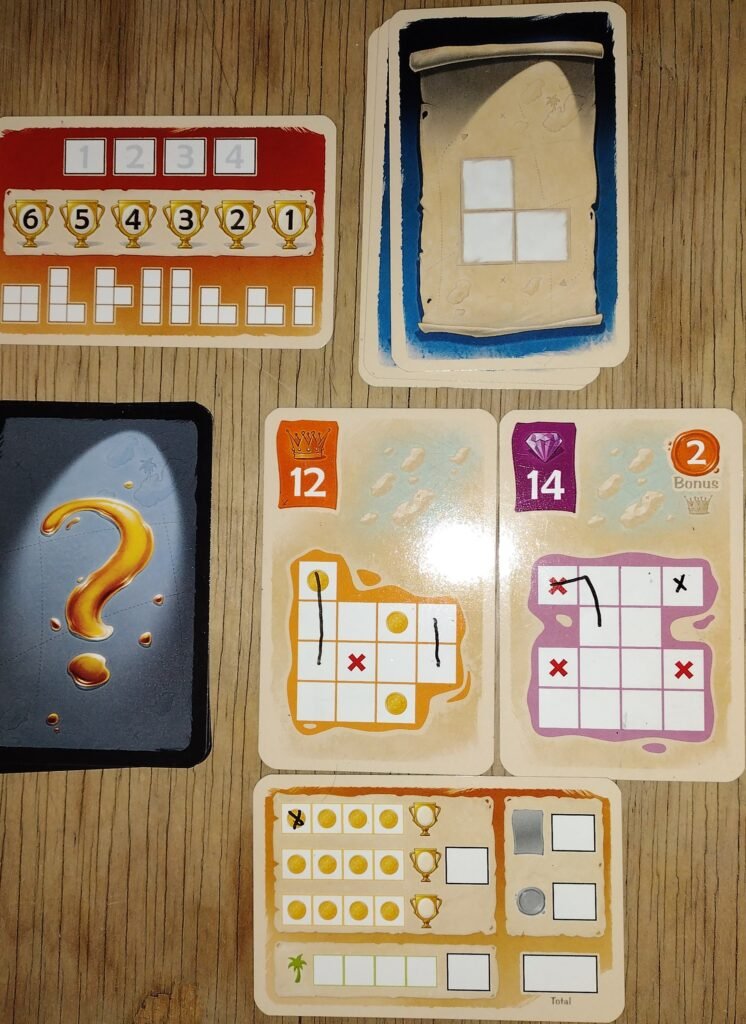
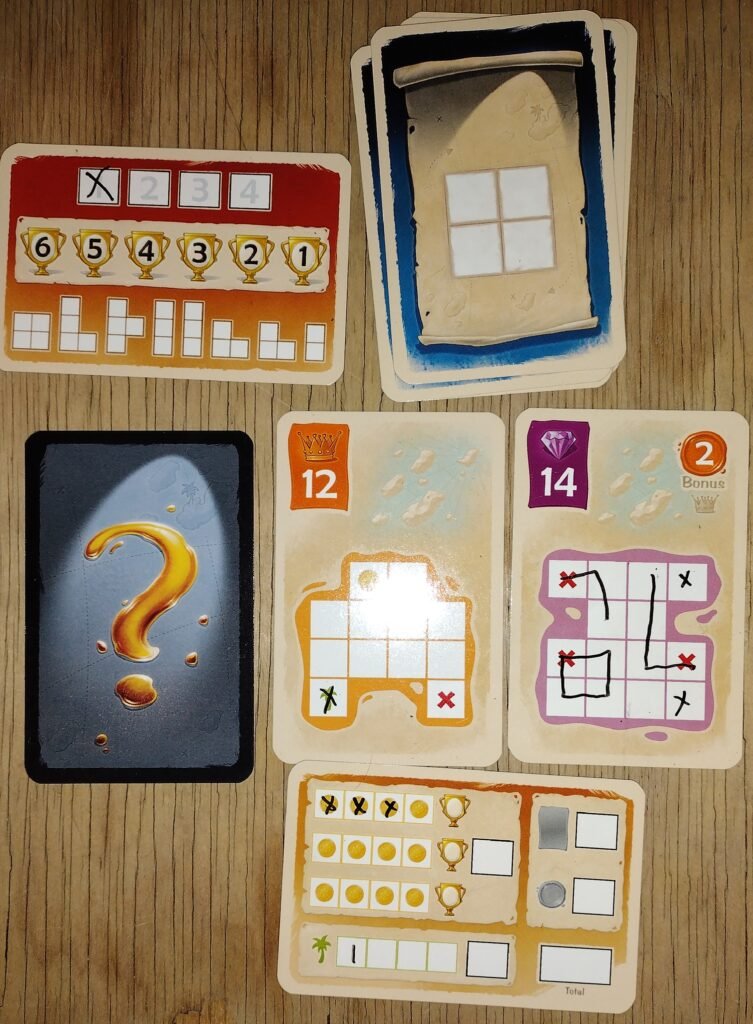
This is after turns 1 and 2. One gold coin is marked off on the card worth 12 points, so a corresponding gold coin is marked off on the score sheet.
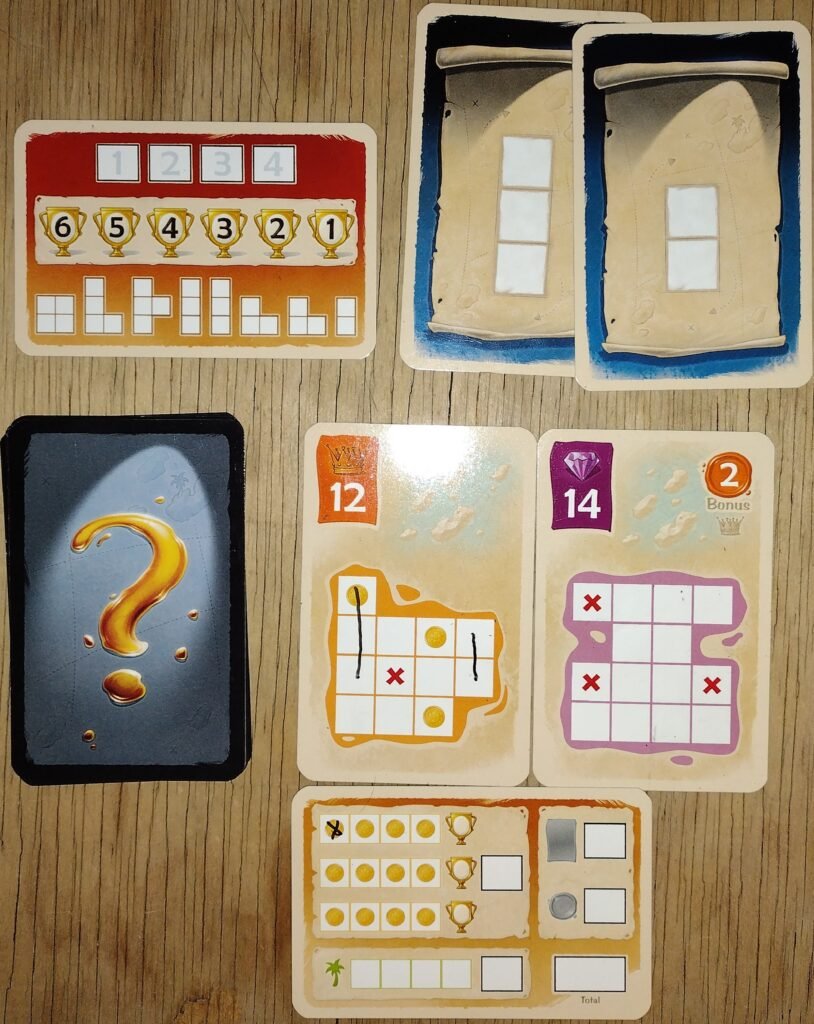
On each turn, one expedition card is drawn and everyone can mark off that shape on one of their treasure cards. Make sure you account for palm tree points and X’s immediately, because there’s no real way to go back and do it later. Gold coins are best done immediately, but can be counted retroactively.
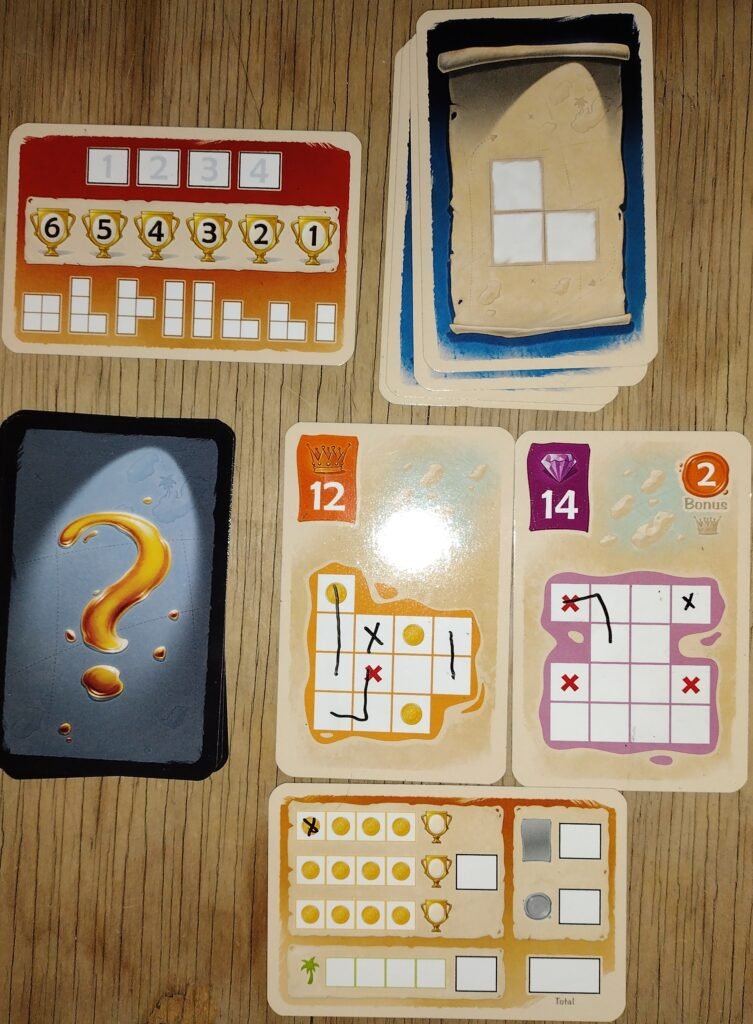
On turn 3, the player marked off a red X so crossed off one extra square.
Silver and Gold Scoring
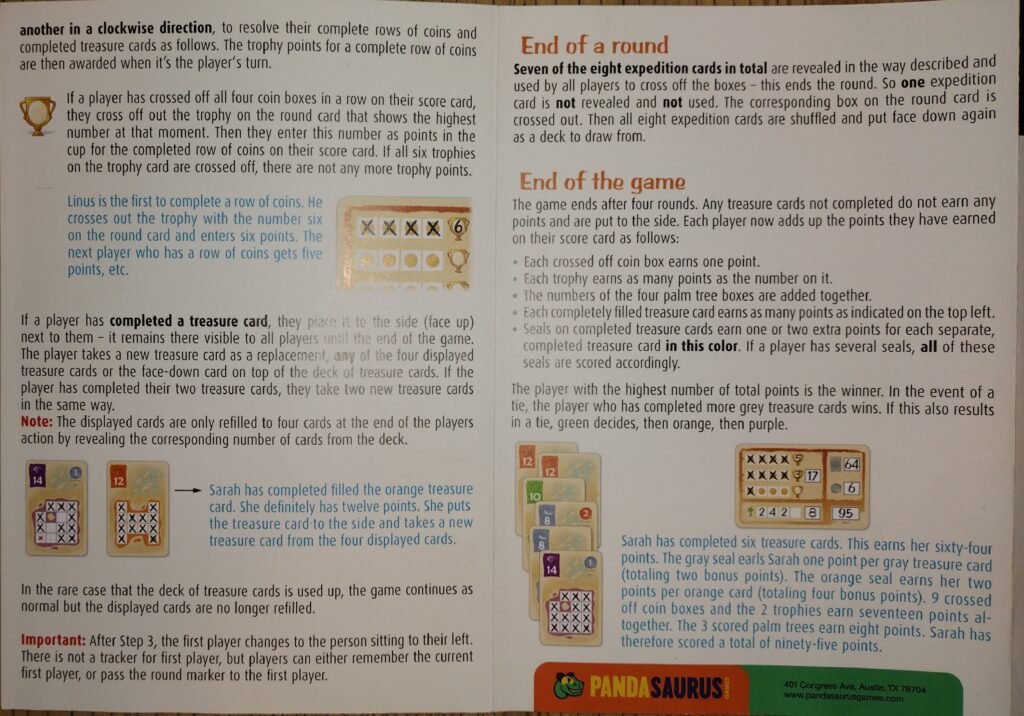
If you fill one of your rows of gold coins, fill in the trophy with points from the round card. The first person to fill a row gets 6 trophy points, the second gets 5, etc. Once 7 of the 8 expedition cards have been used, the round is over and the first-player token is passed to the next player.
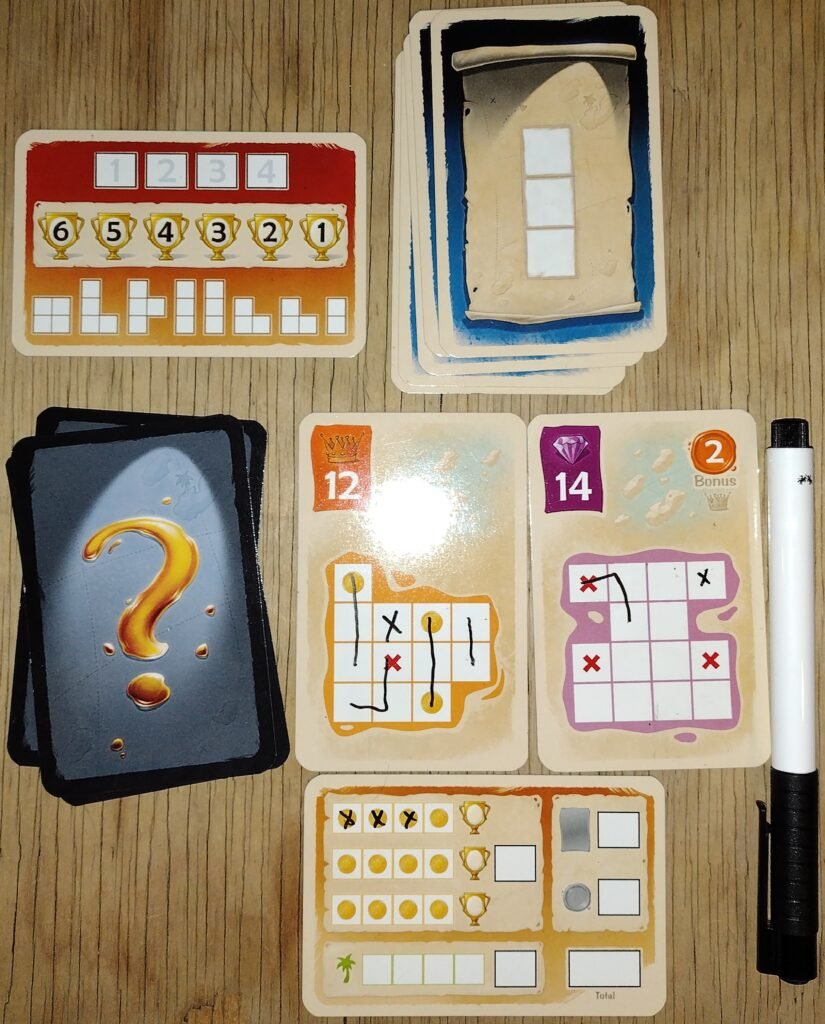
Note that there are two expedition cards with this shape; they just happened to come one after the other. Again, a red X was crossed off so an extra square was also crossed off.
Player order is only important for determining the order of coin trophy points awarded and choosing new treasure cards. So it’s not critical, but we’ve had several times when it’s made a difference.
At the end of the game, points are added up. Each player gets points for completed treasure cards, bonuses, gold coins, trophies, and palm trees. While it’s just addition, it is a fair amount of it and scores around 100 seem to be the norm.
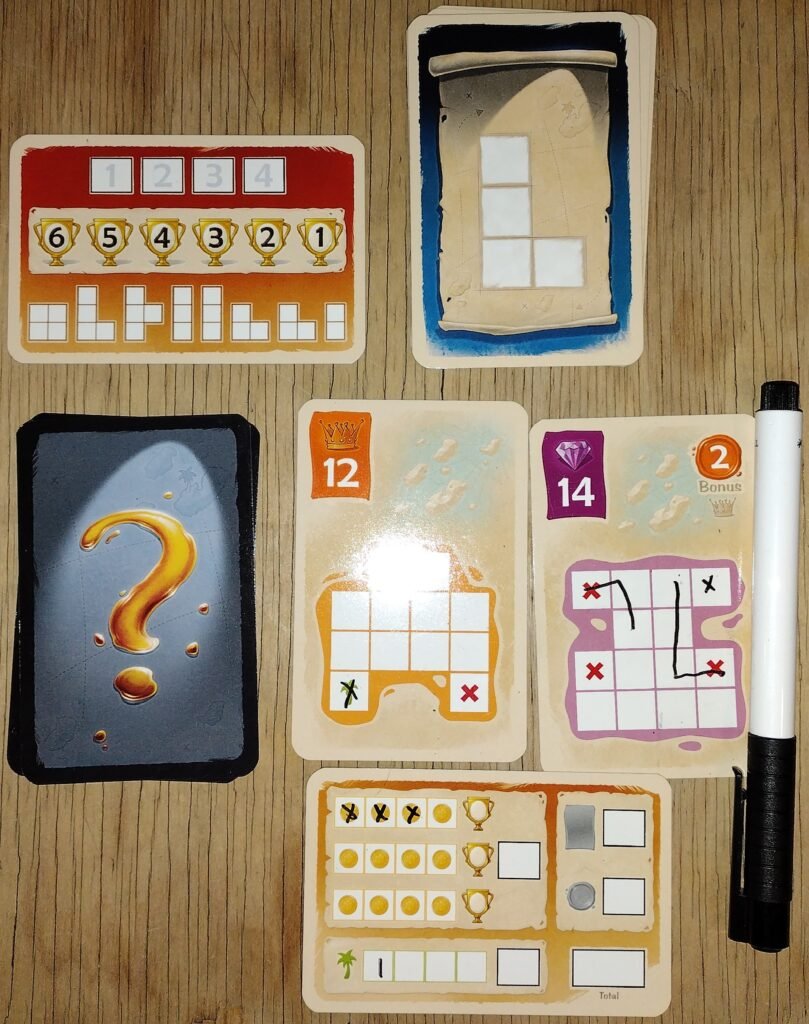
With turn 5, the 12-point card is finished. As long as the 14-point card is finished before the end of the game, this orange 12-point card will be worth 2 extra points.
Luck Versus Logic
There is some luck in that not all of the expedition cards are used each round. (There is always one left unused, but they’re shuffled between rounds so it’s always different and you never know which one it will be.) However, every player gets the same luck as they’re all using the same expedition cards. Since players always get to choose between 4 treasure cards, there is more logic and strategy involved than luck.
A new card is chosen (it doesn’t have to be worth the same number of points, though). Another red X was marked off, so the square with a palm tree was also marked off. Only one palm tree is in play at this time, so it is only worth 1 point.
Personally, spatial awareness has never been my strong suit. And even though my husband grew up playing Tetris frequently, our son won when we played it the other night. It’s wonderful to see my kids’ logic and strategy developing and growing. Additionally, trying to remember what has been used (so you can predict if you might be able to fill your treasure card later) is really good for working memory.
Turn 7 marks the end of the first round. Note the singular square left in the 14-point card; this will have to be filled when the next red X is marked off. You can keep working on the same treasure cards, just reshuffle the expedition cards to start the next round.
While this isn’t a game we have pulled out a ton, it’s a definite winner! And of course, the treasure theme is great, too.