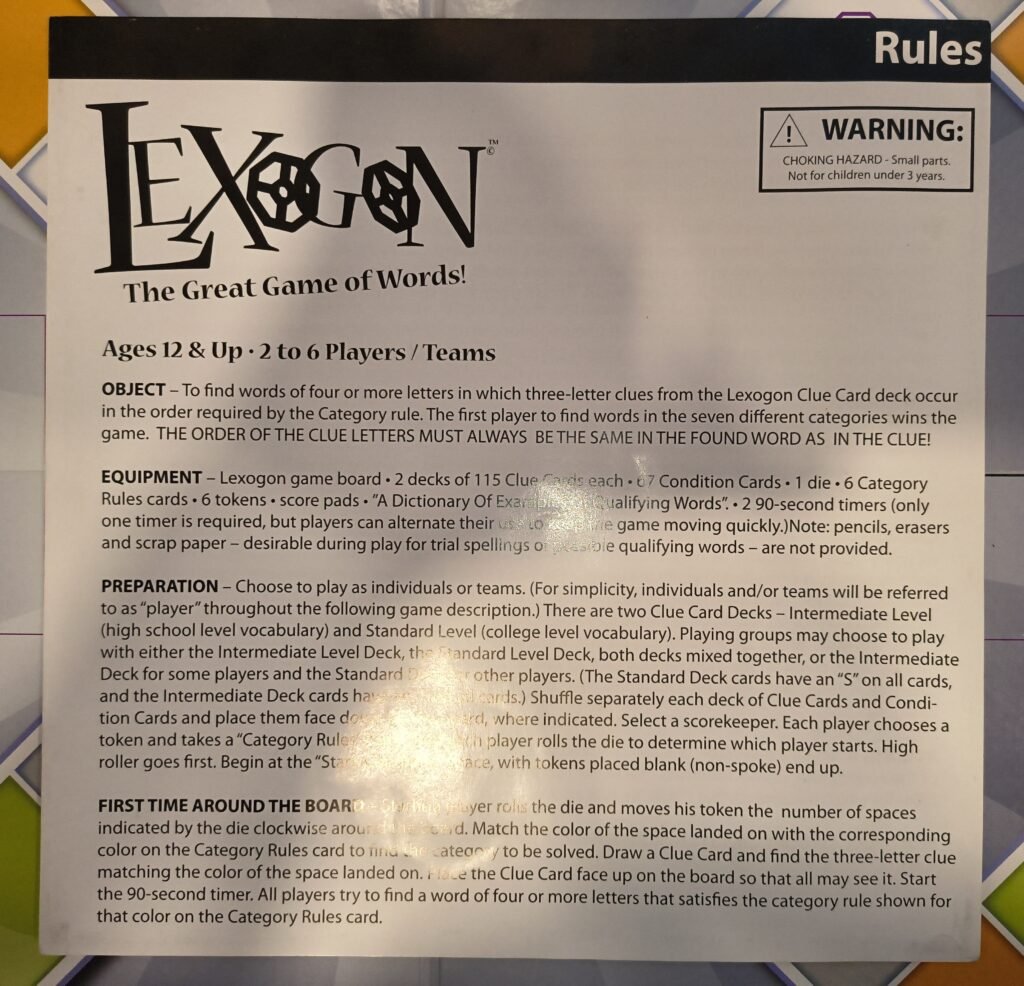
Does your family love word games, but you’re looking for something more than just a spelling game? If your kids are older, check out Lexogon! They did come out with a junior version aimed at middle schoolers, though, called Lexogon One.
This post may contain affiliate links, meaning if you click on it and make a purchase, I’ll receive a small commission at no cost to you. As an Amazon Associate, I earn from qualifying purchases. For more information, please check our Privacy Policy and Disclaimers and Disclosures.
Parts of Lexogon
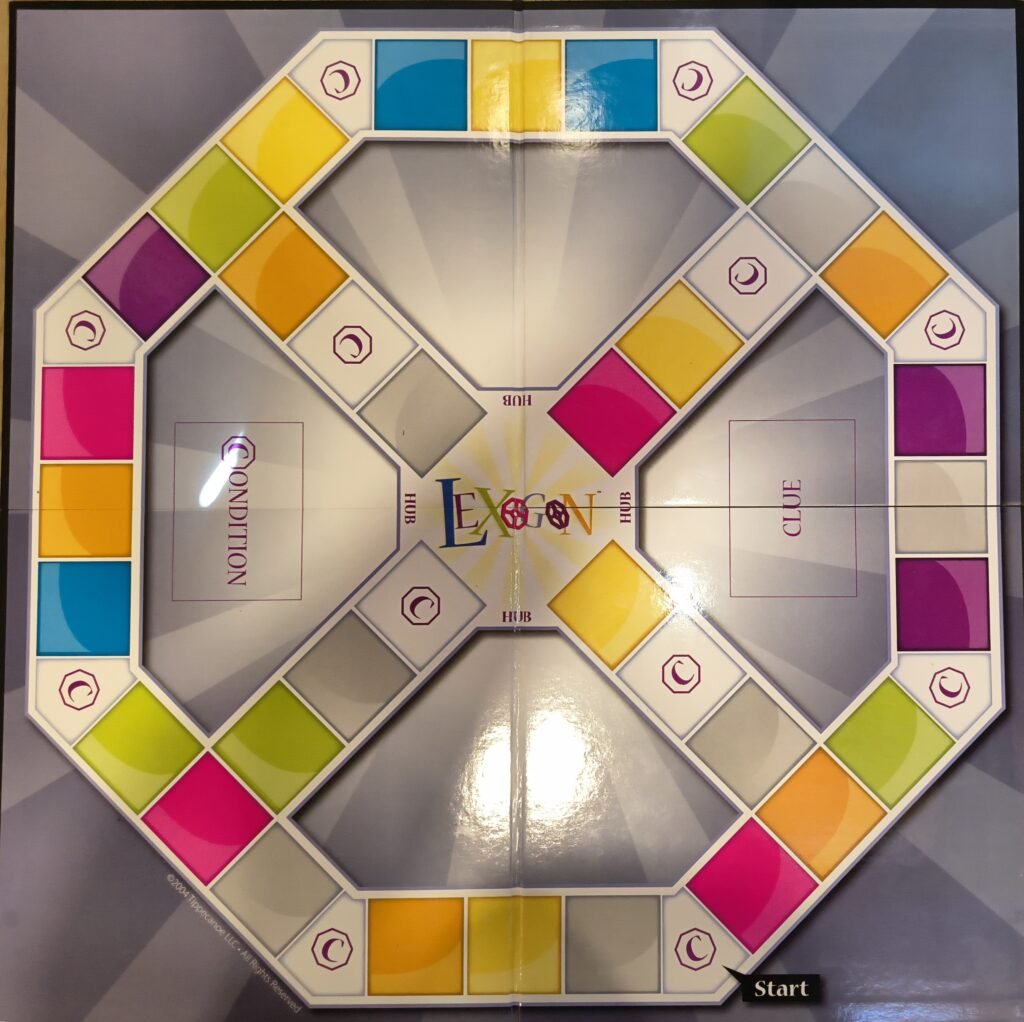
Lexogon is a challenging word game that uses a board. The board has a perimeter path with four spokes going to the hub in the center. Each player chooses their playing piece (there are 6 included) and rolls the die to determine who goes first. There is a small deck of condition cards and a large deck of clue cards.
How to Play
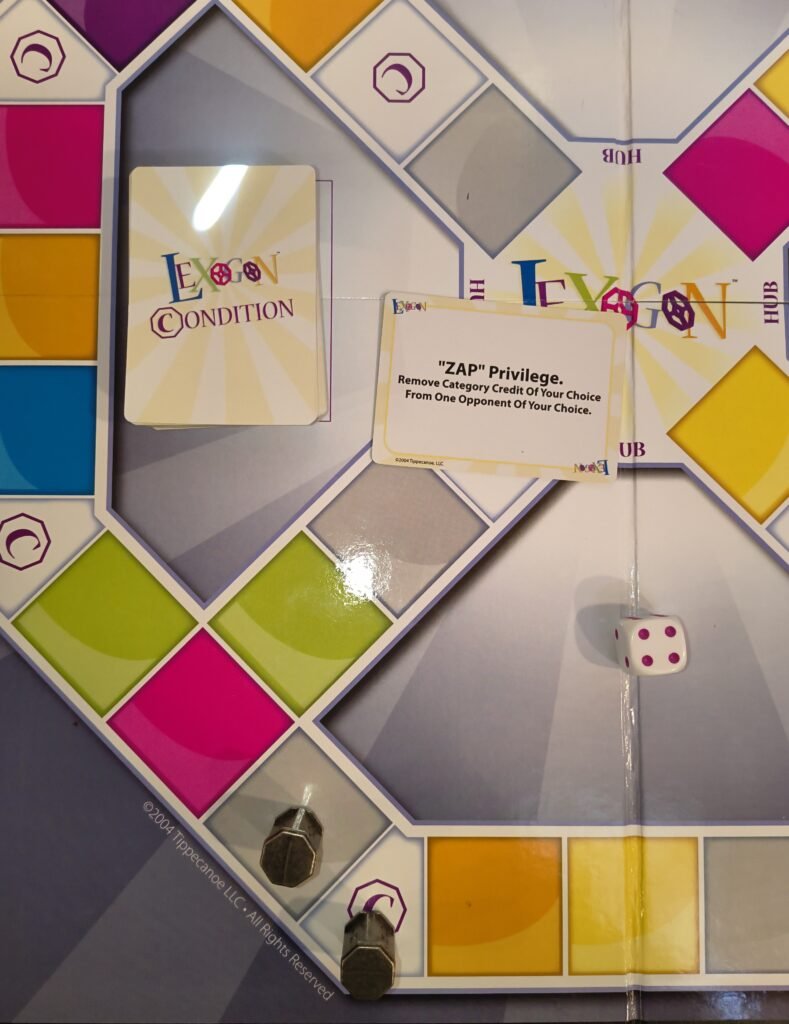
On your turn, roll the die and move the appropriate number of spaces around the perimeter of the board. If you stop at a C space, draw a condition card and follow the directions. Otherwise, draw a clue card.
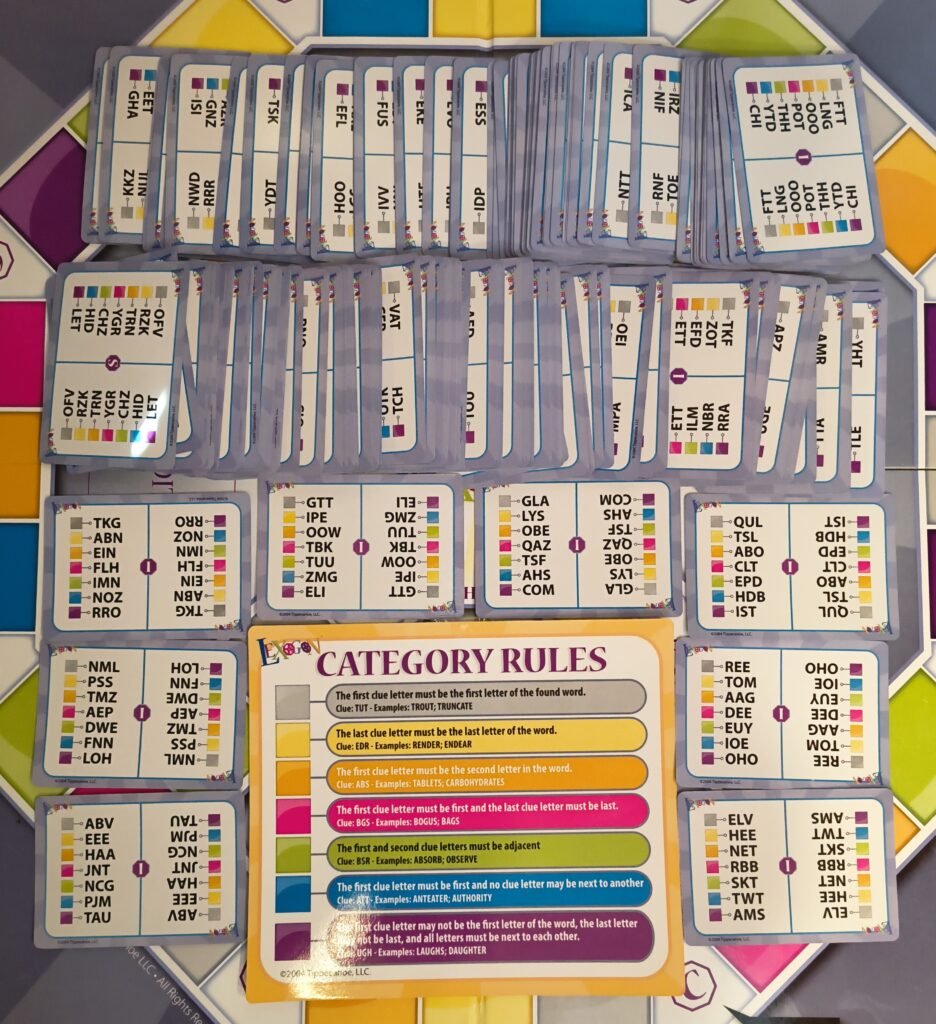
There are 7 categories and each clue card has all 7 categories listed. The color space you’re on determines what category you’ll be playing. (Note: While we did not have color-differentiation issues, there is no other indicator. Colorblind players will likely need assistance determining the category, but this is easily done if someone in the group can differentiate the colors.)
All of the category cards with a category rules sheet
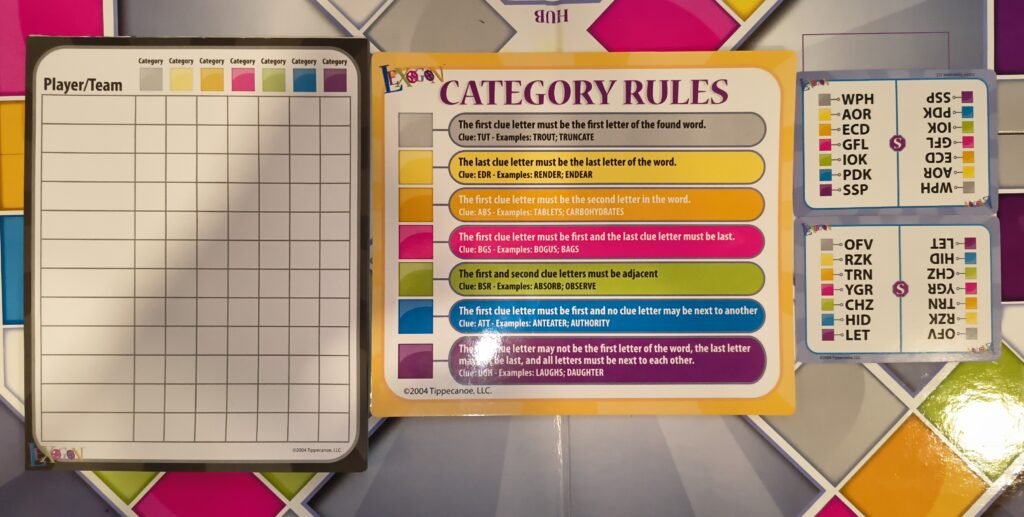
Turn the hourglass timer over and the active player has 90 seconds to find a word that meets the requirements of the categories. If they are unsuccessful, the rest of the players have an opportunity to get credit for the category. It seems like this is supposed to be more of a free-for-all, but we went around in a circle, only getting credit if the previous player was unsuccessful.
Special Rules
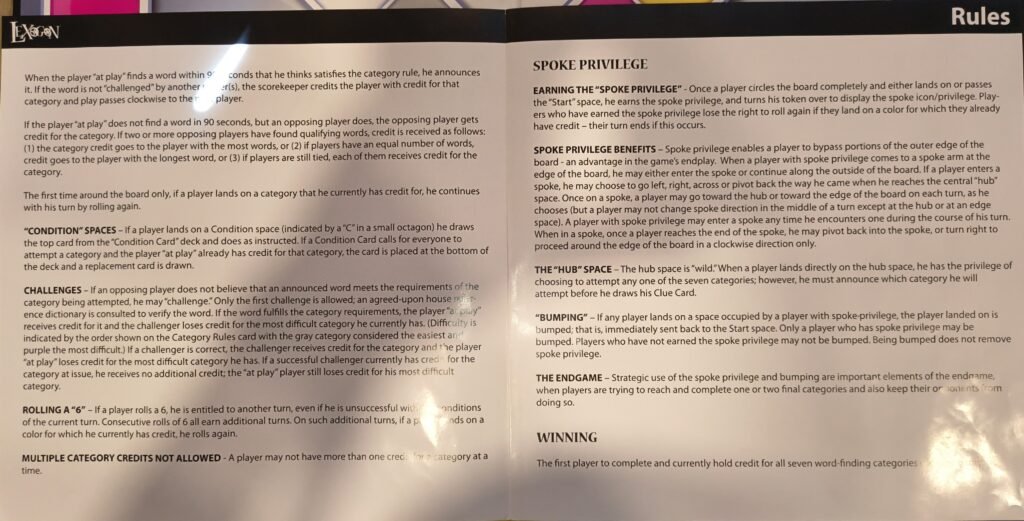
The first time around the perimeter, players roll again if they land on a category they already have, and they can’t be bumped. However, after the first go-around, players can start using the spokes. They still have to proceed clockwise around the edge when they’re on the perimeter, but they can go any way they need to on the spokes. Plus, the hub is wild and they can choose any category.
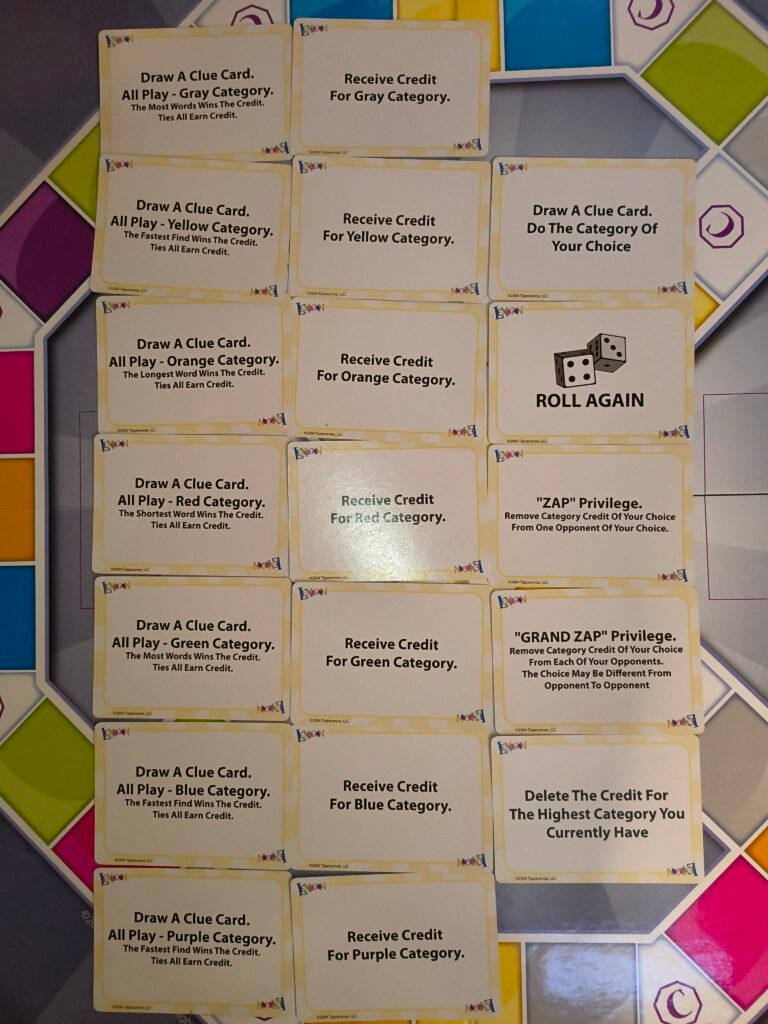
These are all the types of condition cards (there are several repeats). By removing some of them, you can make the game less cutthroat.
Lexogon is a Challenge!
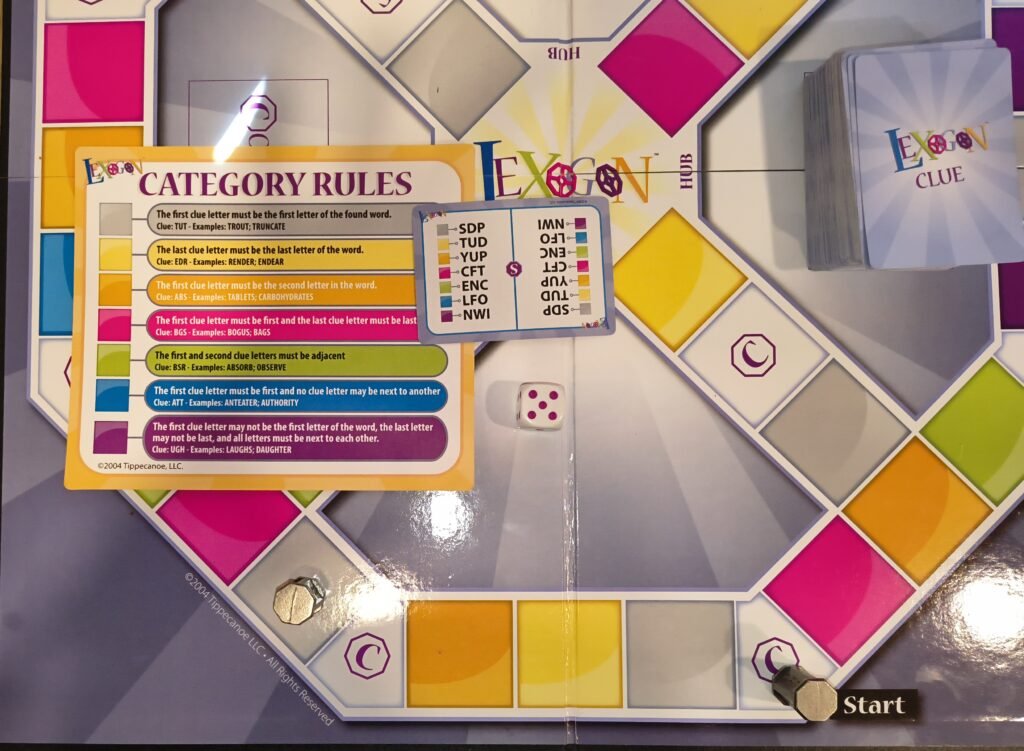
Our kids are relatively new spellers, though they’re worlds better than they used to be. They’re also a bit young for the game at 10 and 12 (the game recommends 12+). Usually, my kids don’t have problems even playing games for ages 14+, but Lexogon was a challenge. We also don’t usually play games like this. I imagine, though, that as we play more, their skills will improve.
Stupendous could work for this clue.
There are some “take-that” elements to the game, but these can be mitigated by slight altering of the rules and removing some of the condition cards. Our biggest roadblock was frustration trying to find an appropriate word. Or thinking you found one, only to be told you didn’t. But again, as we play more, I’m sure we’ll improve.
When you land on a space with a C, draw a condition card and follow the instructions.
Vocabulary Help
Lexogon seems like it would be an excellent tool to help prep for the SAT Reading and Writing component. At least, as long as the SAT questions include vocabulary questions I remember from more than 20 years ago, and as long as you also define words when you announce them. Okay, I wouldn’t use it as the only test prep, but regular play could help students improve their vocabulary in general.
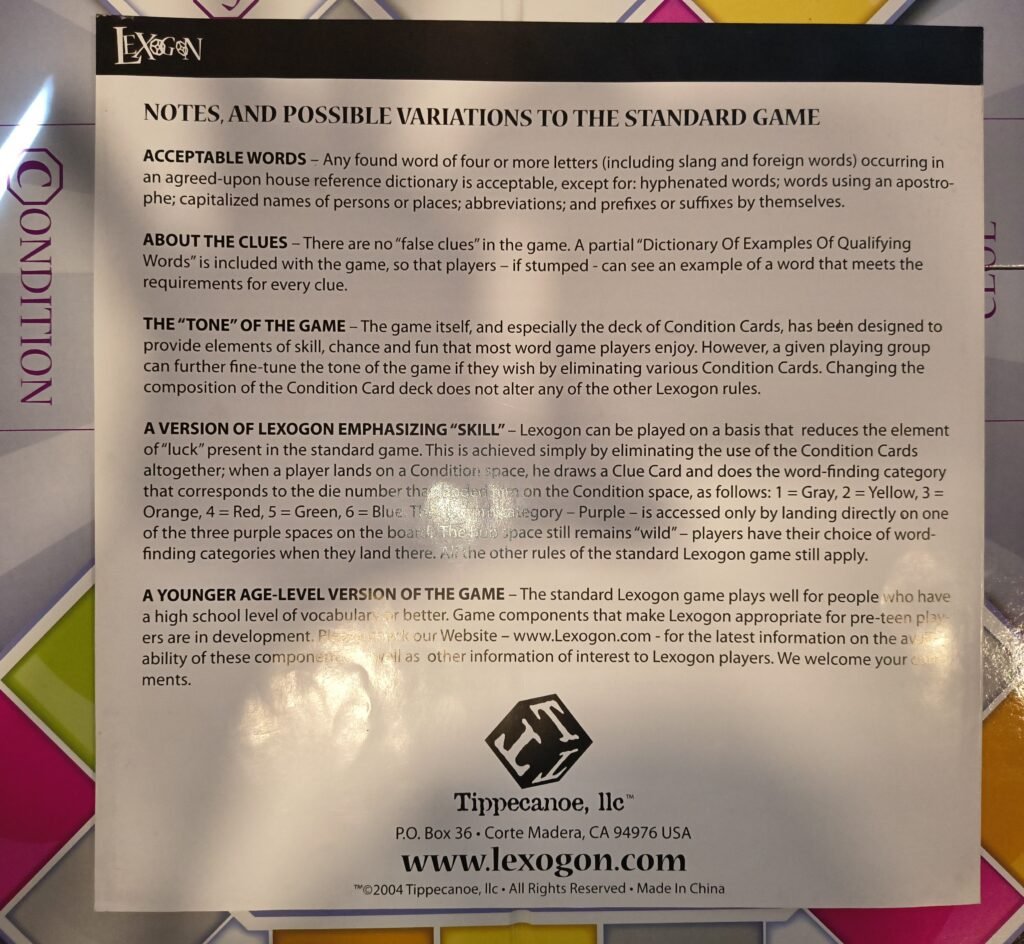
To prove that there are no dud clues, there is a dictionary of examples included. However, we found it to be less helpful and only used it when no one could think of a word.
We’ll be keeping Lexogon, as it is a great game. However, it is on the larger side and it doesn’t seem like you could save a great deal of space by bagging the game. It was enjoyable, challenging, and has excellent educational elements, though. Definitely a keeper if you have the space.

Lexogon Rules