Aliens have landed and need to get specific items from the earthlings they encounter in First Contact. However, they don’t speak the same language and must muddle their way through with symbols the earthlings don’t necessarily understand. Will you be one of the aliens or one of the earthlings? Can you communicate without speaking?
This post may contain affiliate links, meaning if you click on it and make a purchase, I’ll receive a small commission at no cost to you. As an Amazon Associate, I earn from qualifying purchases. For more information, please check our Privacy Policy and Disclaimers and Disclosures.
Setting up First Contact
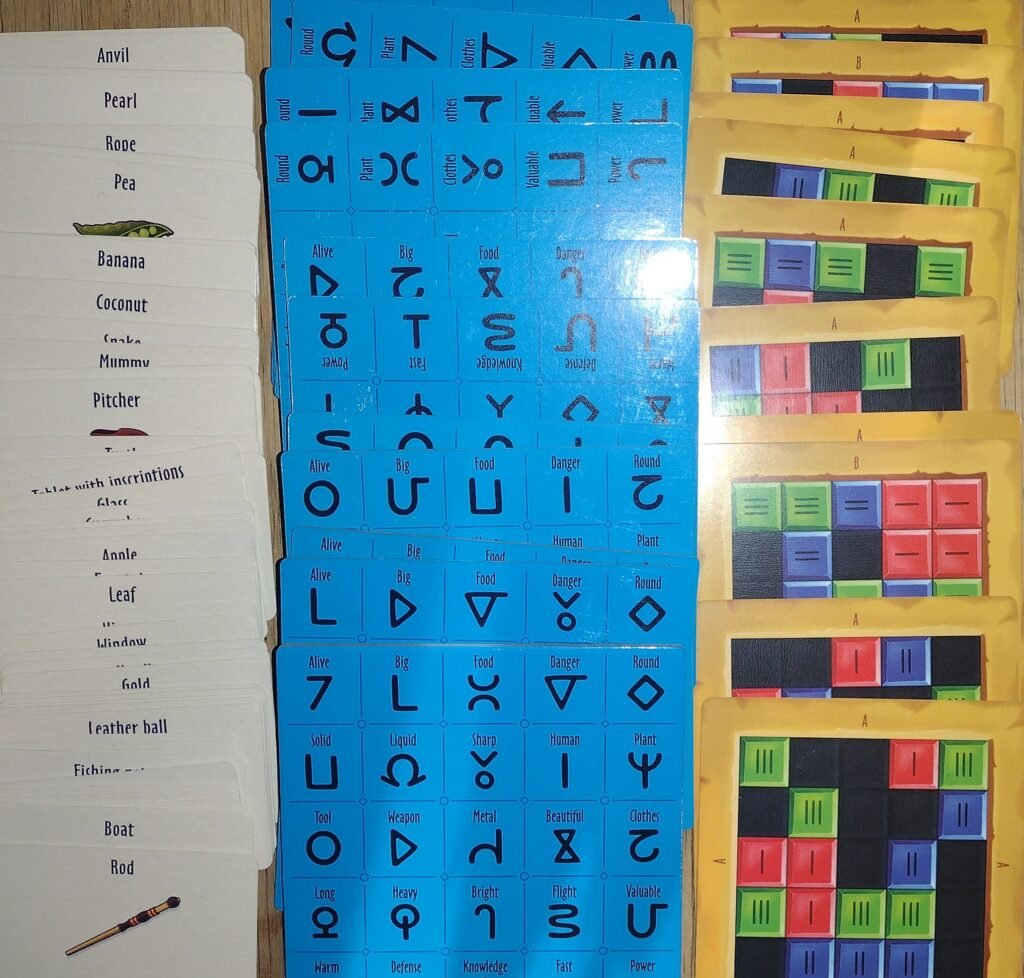
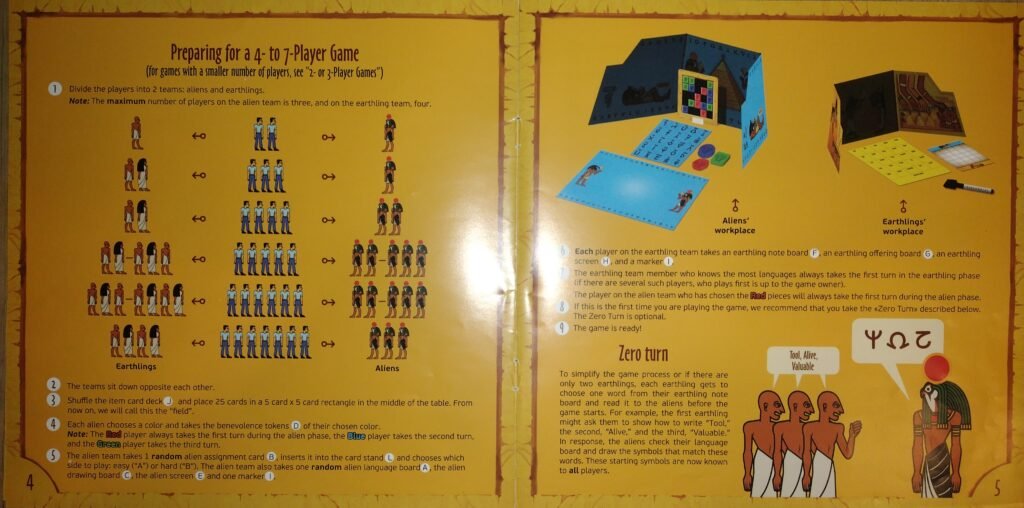
How many aliens you have will depend on how many players are playing. With two or three players, only one will be an alien. Up to seven people can play First Contact, with a maximum of three aliens and four people. Arrange the aliens on one side of the table and the people on the other. In the middle, place 25 item cards in a loose 5×5 grid. (You want space between cards because you’ll turn the cards 90° during the game.)
Each card is double-sided, so there is plenty of replay possibility!
The aliens set up the privacy screen. They choose one of the blue cards, which determines the meaning of each symbol. They choose one assignment card and place it into the stand. Make sure all the aliens agree on which sides are which! Finally, they get the blue dry-erase board.
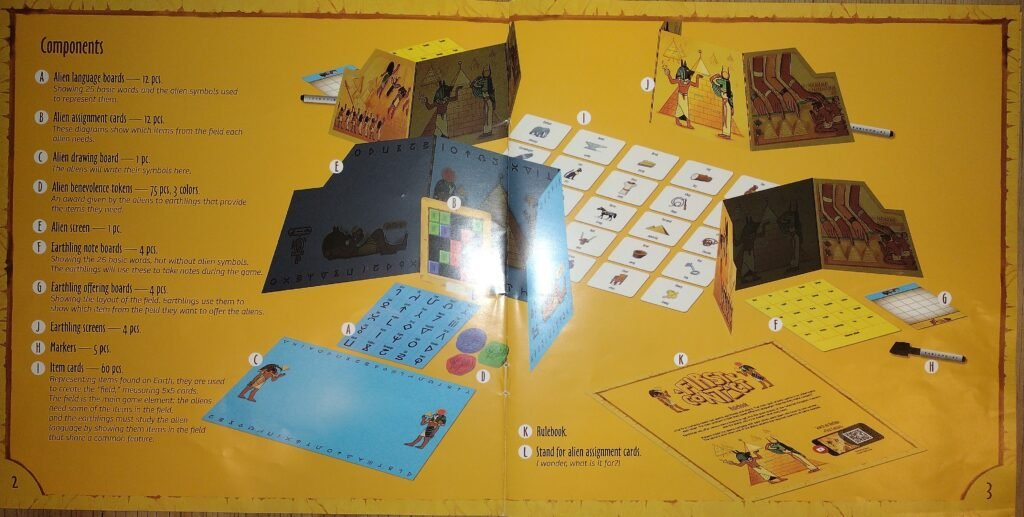
Each earthling gets a small dry-erase grid board and a yellow language card. The language card has all the words the aliens have symbols for, and the earthlings will do their best to figure out what each symbol means. They can draw the symbols below the corresponding word. The small grid is for the earthlings to indicate what item they want to give to the aliens.
How to Play
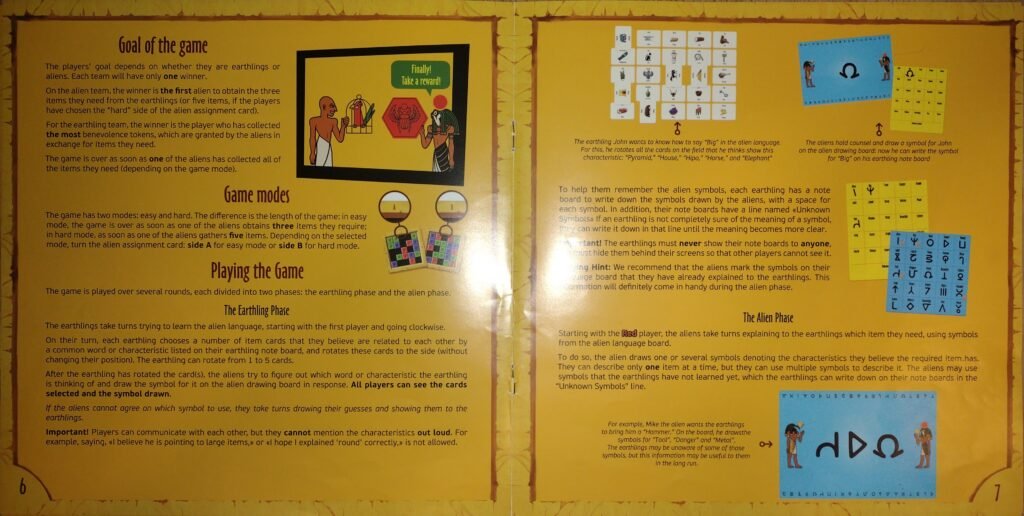
We like to start with a “zero turn.” This makes the game easier, but you don’t have to use it. If you do, each earthling takes a turn saying (out loud) one of the words from their language board. The aliens then draw the symbol for that one word. This gives you a bit of a starting point, which is very helpful.
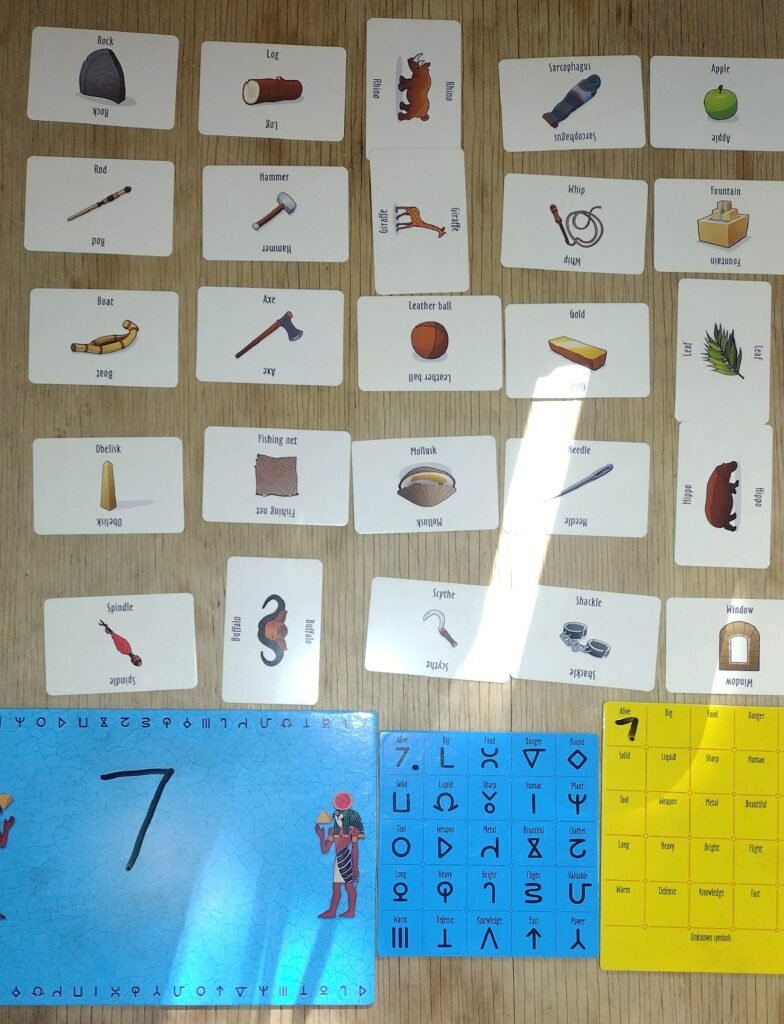
Every other turn has two parts: the earthling phase and the alien phase. During the earthling phase, each earthling takes a turn. On their turn, they rotate up to 5 of the cards in the grid 90°. These cards should all have something in common. For example, if I want to know the symbol for “big,” I might rotate an elephant, buffalo, house, catapult, and pyramid. You want to be careful, though, that you don’t turn cards that could all be described by more than one word! (In my previous example, if I turned elephant, buffalo, giraffe, hippo, and rhino, the aliens might think I wanted to know the symbol for “animal” or “alive.”) The aliens then draw the appropriate symbol on their whiteboard.
With both plants and animals, and not always common food items, this earthling could be looking for the word “alive.”
First Contact: Drawing, Guess-Work, and Logic
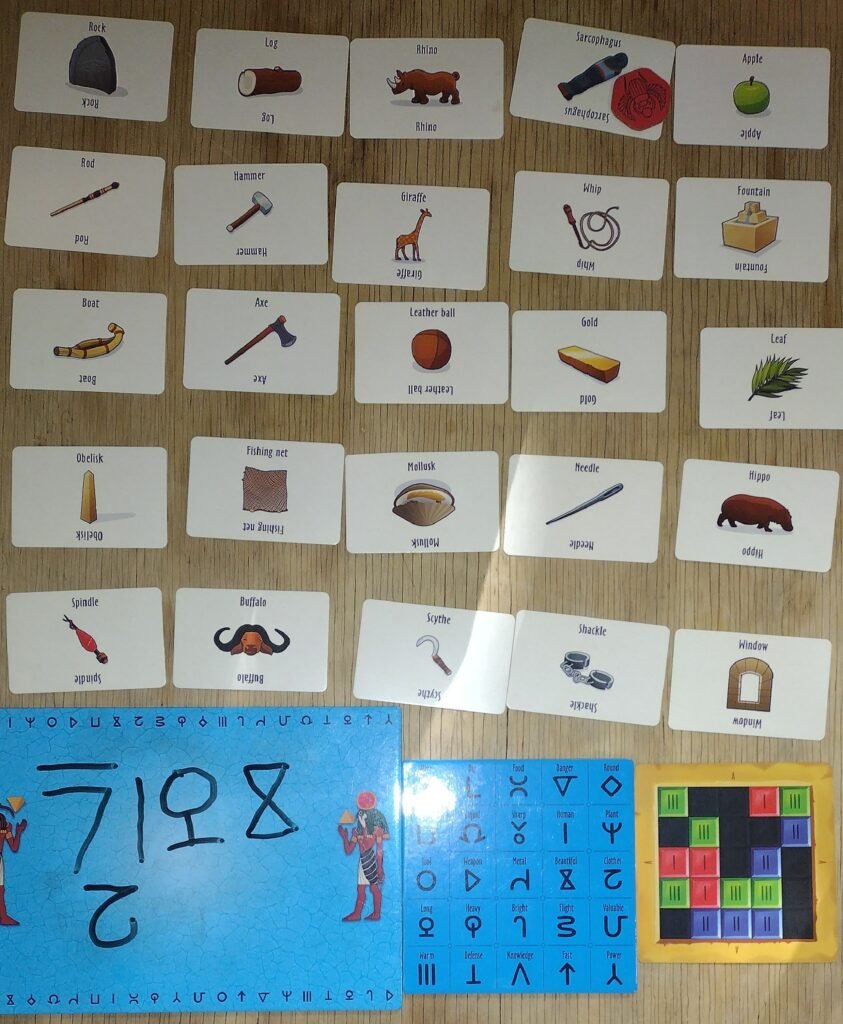
During the alien phase, aliens take turns, each asking for one item that they need (as shown on the assignment card). They do this by drawing symbols on their dry-erase board; hopefully, the earthlings know at least some of these symbols. They can use a horizontal line over a symbol to mean “not [that symbol].” Each earthling then indicates on their small, dry-erase grid which item they think that alien is asking for. They can also use this time to maybe figure out some more symbols.
The alien is looking for the sarcophagus here, so has begun with “not alive.” They’re reasonably sure the earthlings know this symbol. The rest, the earthlings might not know.
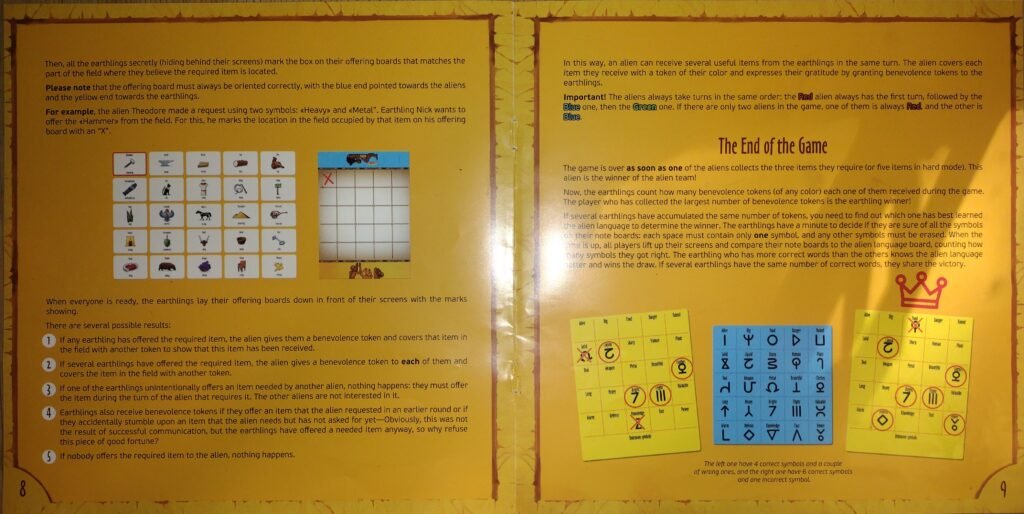
There are two winners: one alien and one earthling. The first alien to collect all of their needed items is the alien winner. The earthling to collect the most benevolence tokens (earned when an alien gets a needed item) is the earthling winner.
I love this game. This kind of clue-giving and unraveling is really fun and interesting for me. However, it can also be very frustrating, especially if you are playing with people who aren’t good at giving or deciphering clues. The necessity to NOT talk about the words, clues, or items makes it a challenge for younger kids. (Remember Ultimate Werewolf? First Contact is also unplayable if players talk about the game.)
Best for Older Players
First Contact’s game box says it’s for ages 14 and up. I think, depending on the kid, you could go a few years younger. My kids are 10 and 12 and still struggle with the game, though. There is nothing inherently inappropriate or very unsafe about the game. (The benevolence tokens are on the smaller side, but they’re cardboard, so I wouldn’t worry too much about a toddler putting one in their mouth, but the possibility is there.) However, the abstract thinking and the need to not discuss things make it a more challenging game.
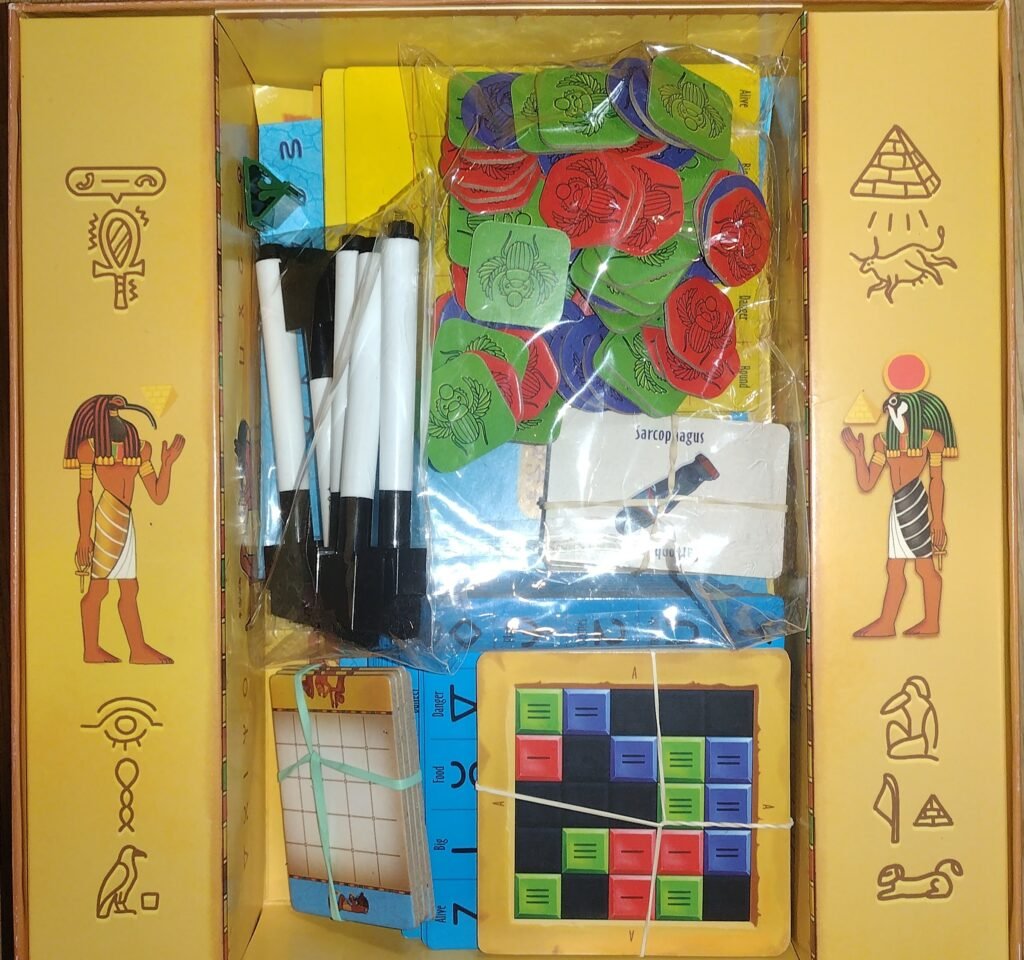
Overall, if your family enjoys Covalence or Codenames and is looking for something more challenging, First Contact might be the perfect game for you!