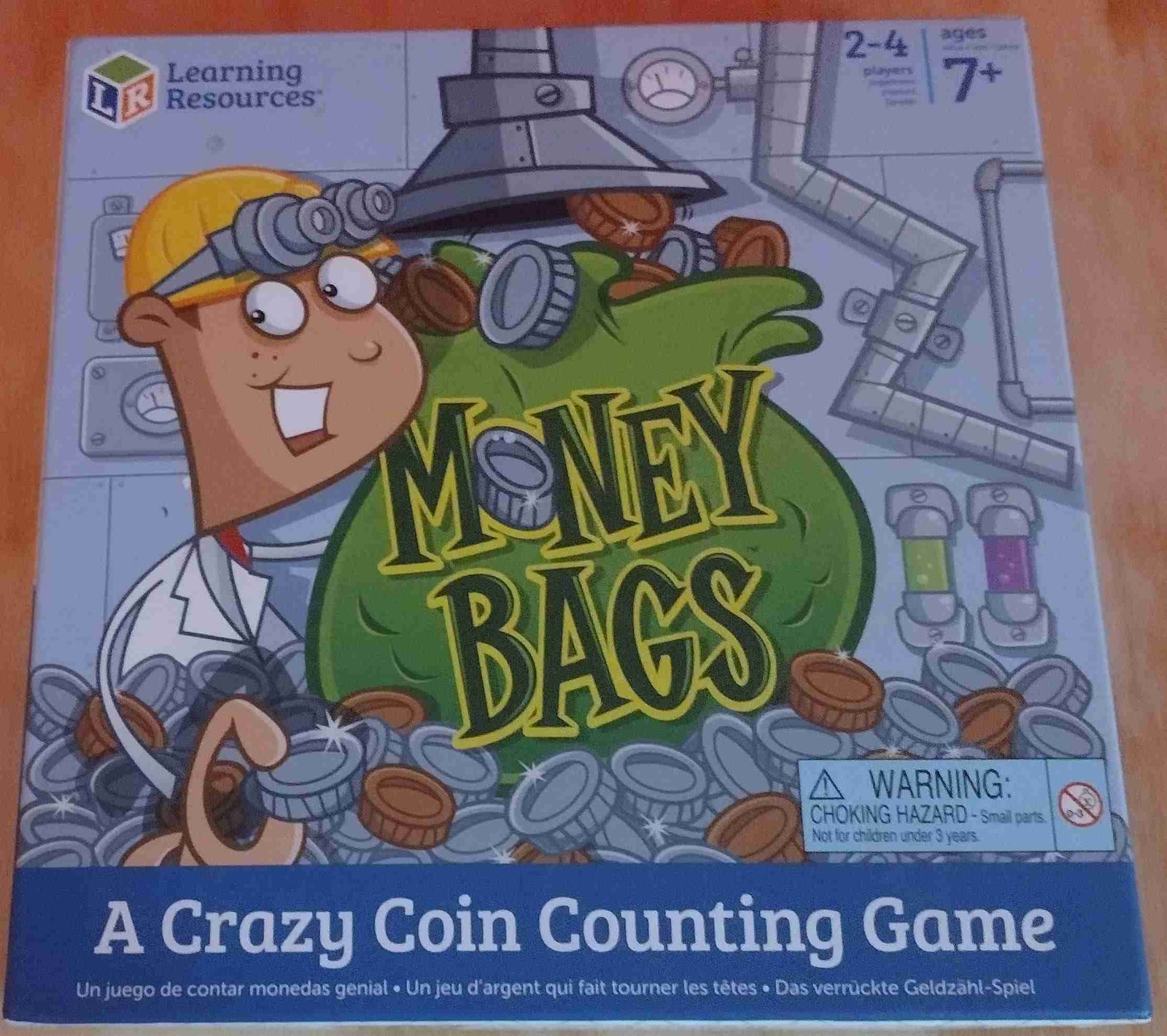
Learning how to count money is so important, yet can be a tricky concept for many kids. In addition to some games, my kids got real-world experience working with their own actual money. You have several options for money games; we used Money Bags.
This post may contain affiliate links, meaning if you click on it and make a purchase I’ll receive a small commission at no cost to you. As an Amazon Associate, I earn from qualifying purchases. For more information, please check our Privacy Policy and Disclaimers and Disclosures.
Money Bags is our game for learning coins. The concept is simple. You roll the die to determine how far you need to move your marker. Most spots have an amount less than $1 on them, some spots are “change it up” spots, and some spots are “money bag” spots.
How to play Money Bags
For the spaces that have a coin amount on them, you spin the spinner, which tells you what kind of coin you can’t use. Then you collect the amount on the space you landed on. For example, if you land on “26¢” and spin up “no quarters”, you can collect 2 dimes, a nickel, and a penny. For my own sanity, we have a house rule that you have to use the fewest coins you can.
On the “change it up” spaces, you count out your money and change at least one aspect of how it’s represented. I always encourage my kids to simplify and end up with the fewest coins possible, but if you just “changed it up” and are already simplified, you could just exchange a dime for 2 nickels. Once you do this, you get a dime. It’s not in the rules, but we’ve allowed our kids to use their anticipated dime to help them further simplify the money in front of them (if they counted up 90¢, they could exchange all that, plus their anticipated dime, for a dollar bill).
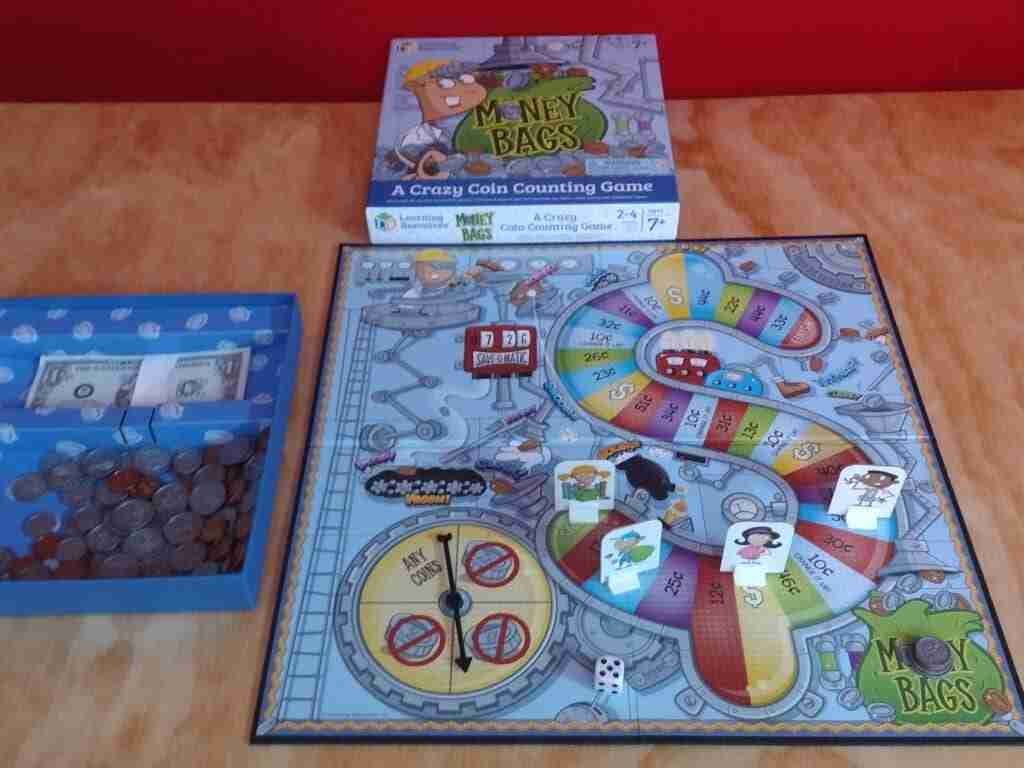
The spinner is built into the board
I have mixed feelings about the spinner, which is attached to the board. On the one hand, I like that there’s one less thing to pass around the table. I get overwhelmed when there’s too much chaos, and when gaming with 2 kids, there’s always a lot of chaos. Any amount of limiting that chaos is a win for me.
On the other hand, it drives me low-key nuts that the board doesn’t fold up flat. There’s the spinner in there lifting up one side. It can also be a bit frustrating when you have a kid that *needs* to do everything themselves, but the spinner is on the opposite side of the table. Or when both kids need to do everything themselves, but will endlessly poke and annoy each other if they’re sitting next to each other. We work around it, but it’s one of those things that I see both pros and cons.
Criticisms of Money Bags
Criticisms I have heard about Money Bags are that it uses fake money and its portrayal of people of color. Now, the fake money I understand. Sure, it’s not terribly realistic, but if it’s proving confusing for your kiddo, just replace it with some real coins. My kids have had ample other opportunities to interact with real money, and the fake money in this game hasn’t been a problem for them, but I can see how it could be confusing for some kids.
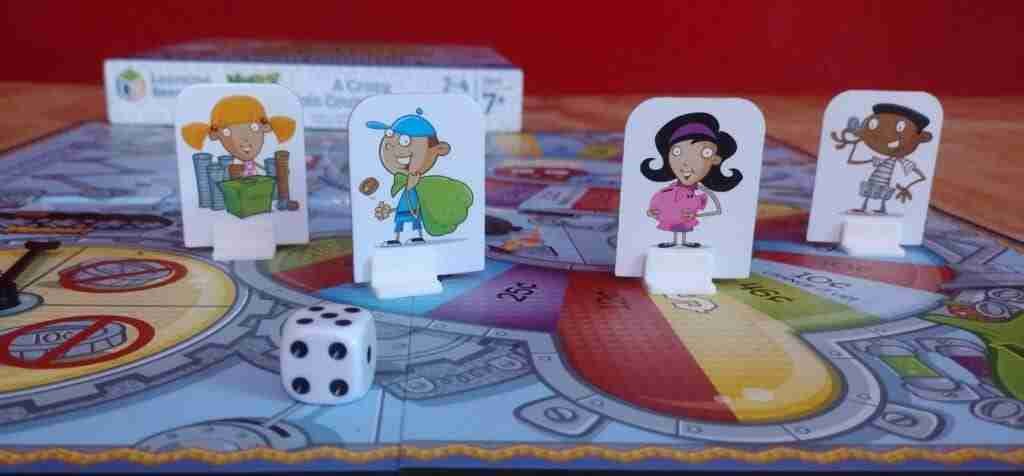
More concerning, is the portrayal of people of color. Being a white person myself, it wasn’t something I noticed until it was pointed out to me. Now I can’t unsee it and feel compelled to mention it. Both of the white kids have big piles of money, while both the POC are pictured with much smaller piles. Part of me says that you could just create your own pawns, use generic ones from other games, or just draw more money onto the POC pawns provided with the game. However, the other part says that I, personally, wouldn’t feel terribly comfortable supporting a game company (Learning Resources, for those wondering) that portrays POC like this, particularly if I already intended to modify it to make it more acceptable.
Other ways to teach kids about coins
There are a lot of other ways to teach kids about coins. There are several other games (I believe Exact Change and the Allowance Game might be two of them, but we don’t have them so I can’t speak to them). Money Bags just happens to be the game I heard about first and purchased early in our gameschooling journey.
I pay my kids for doing chores, generally in coins. I’ve also taught my kids how to play poker. I distribute coins, we play a few hands, and the kids get to keep whatever they’re left with. They LOVE this way, because they always end up making at least a bit of money, since we’re not gambling with their own money.
When they want to purchase something, they can take their money and figure out how to pay for it. (Pro tip: Always have them figure this out before you’re at the register. We’re currently in an area that has about 9% tax, so I quickly figure out 10% for them and have them add that on.)
Since we have the game, we still love and play it
Overall, though, this game is a win for our family. There’s no actual strategy involved, so the kids can use their full brain power to figure out the coins. And, it’s kind of fun having a game where whoever consistently rolls lowest will almost always win. If you’re still not sure, head on over to our play-through video on YouTube to help you determine if Money Bags is right for your family.