Dragonwood is a game of dice, cards, adventurers, and monsters. It’s another game by Gamewright, so it’s sure to be a winner!
This post may contain affiliate links, meaning if you click on it and make a purchase I’ll receive a small commission at no cost to you. As an Amazon Associate, I earn from qualifying purchases. For more information, please check our Privacy Policy and Disclaimers and Disclosures.
There are two decks of cards: 64 Adventurer cards with a red back, and 42 Dragonwood cards with a green back. Keep the two decks separate. The Adventurer cards are shuffled, and everyone is dealt five cards. The hand limit is nine cards. On each turn, you can choose whether to reload your hand or attempt to capture a Dragonwood card.
Setting up Dragonwood
When setting up your Dragonwood cards, first find the two dragon cards and pull them out. Next, the instructions will tell you how many Dragonwood cards to pull out of the game depending on how many people are playing. However, you can also use this to lengthen or shorten your game depending on your players. If you are playing with young children with shorter attention spans, then remove more cards so you can have a shorter game. If you and your kids know you love this game and never want it to end, feel free to leave more cards in.
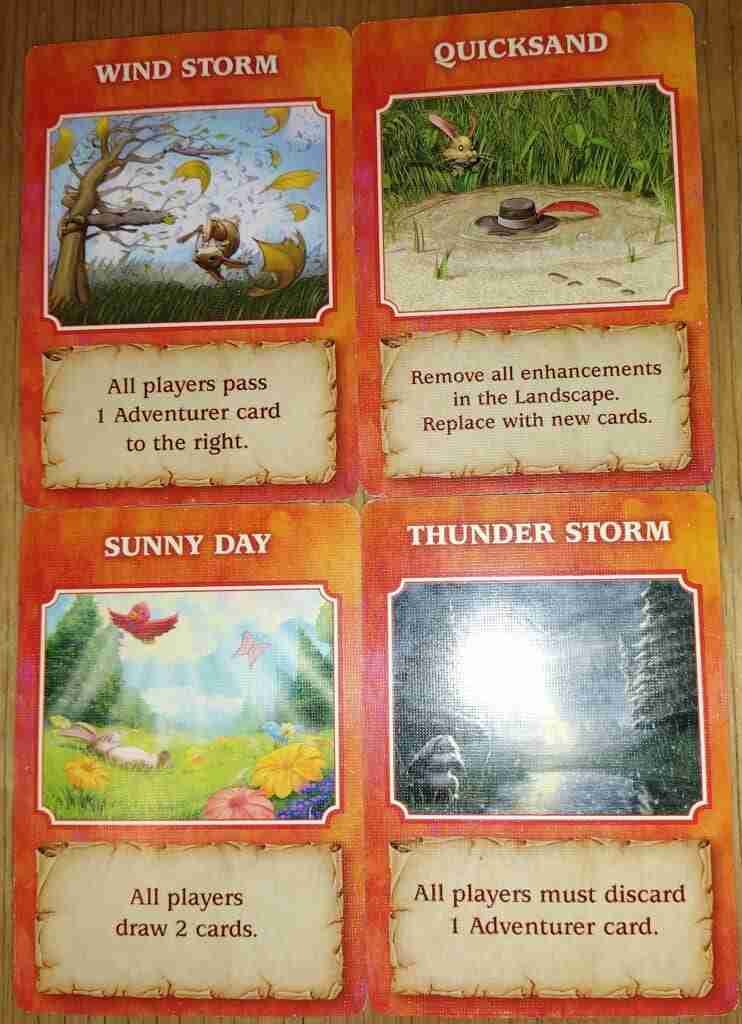
Finally, the dragon cards get shuffled into the last half of the deck. Deal out five cards from the Dragonwood deck, face-up. Most of the cards in this deck are monsters that you can capture for points. Some are enhancements that you can capture to later use to help capture other creatures. And still other Dragonwood cards are event cards that take effect immediately and are then replaced.
These are the four event cards in the Dragonwood deck.
Creature cards are worth different point values
Each of the creature cards are worth a different number of points; between 1 and 7. Every creature card and every enhancement card can be captured one of three ways: with a stomp attack, a scream attack, or a strike attack. You use your adventurer cards to determine which attack you will make.
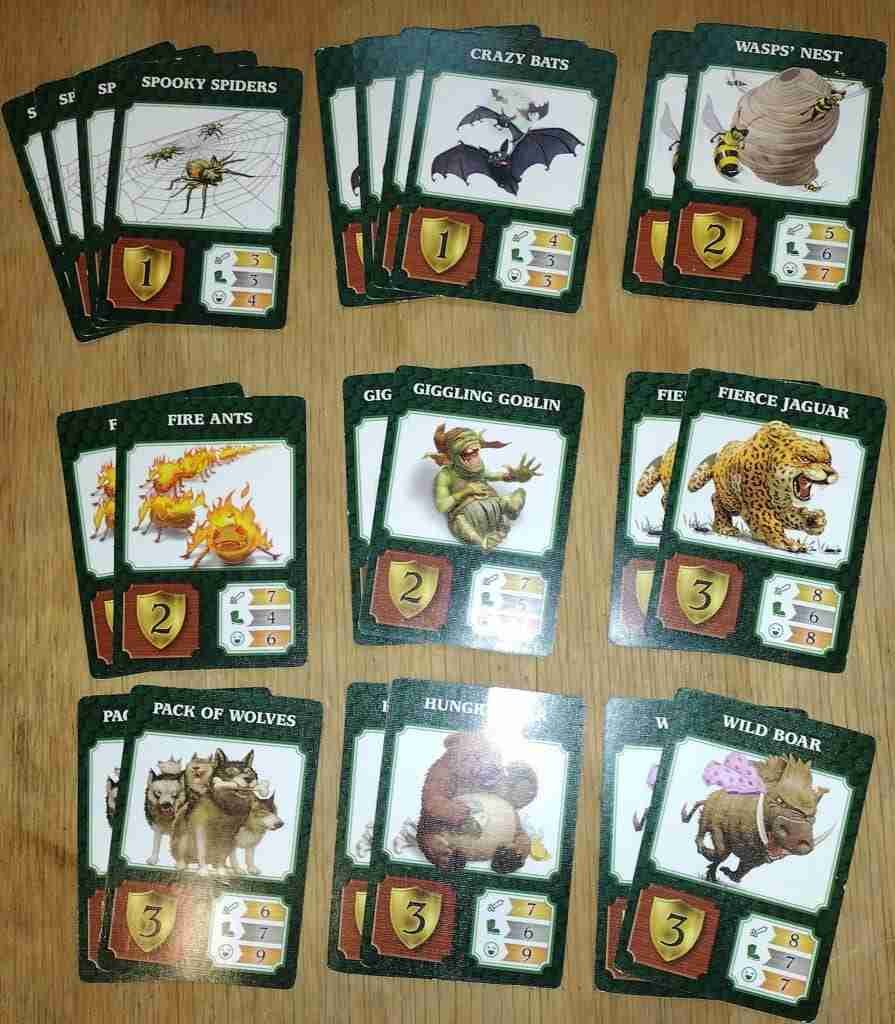
These are the low-point creature cards. Collectively, they’re worth a total of 44 points, and they’re easier to capture than the higher-point cards.
Adventurer cards are one of five suits, and numbered 1-12 (there are also four Lucky Ladybugs in this deck; these allow you to draw two extra cards). So when you want to capture one of the creature or enhancement cards, you use up to six cards from your hand in one of the three attacks.
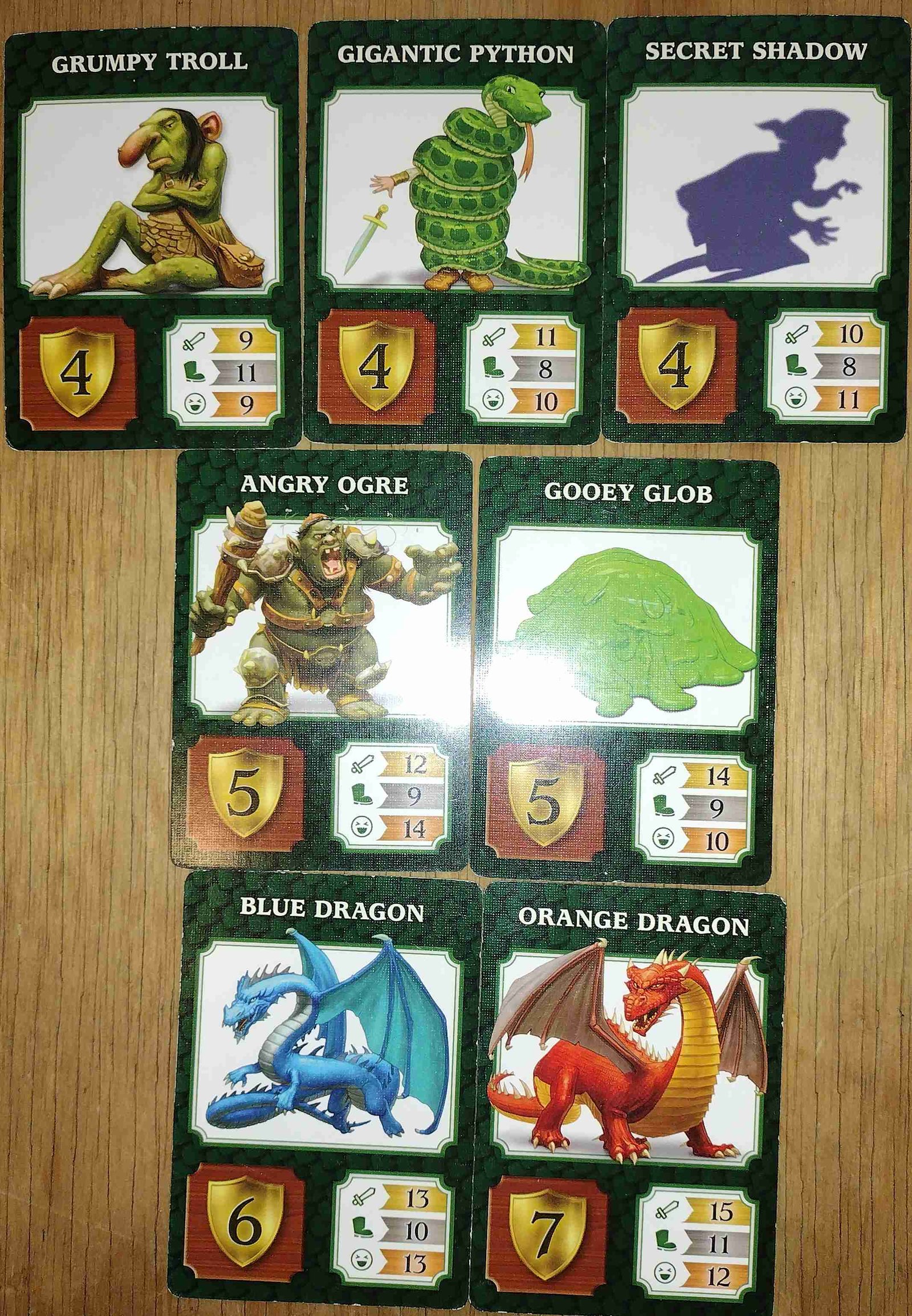
These are the rest of the creature cards in the Dragonwood deck. There are only one of each of these cards. They’re worth more individually, but collectively, they’re only worth a total of 35 points, and they’re much harder to get.
The different attacks in Dragonwood
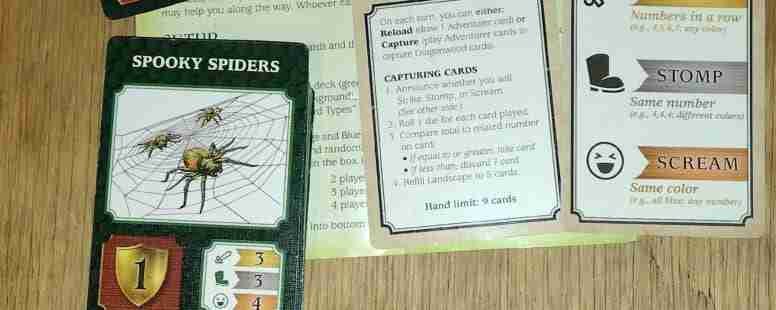
A strike attack requires your adventurer cards to be in numerical order, like a straight in poker or Yahtzee. It doesn’t make a difference whether your cards are high or low, just that they’re in numerical order and how many there are (you can have a 1-card attack).
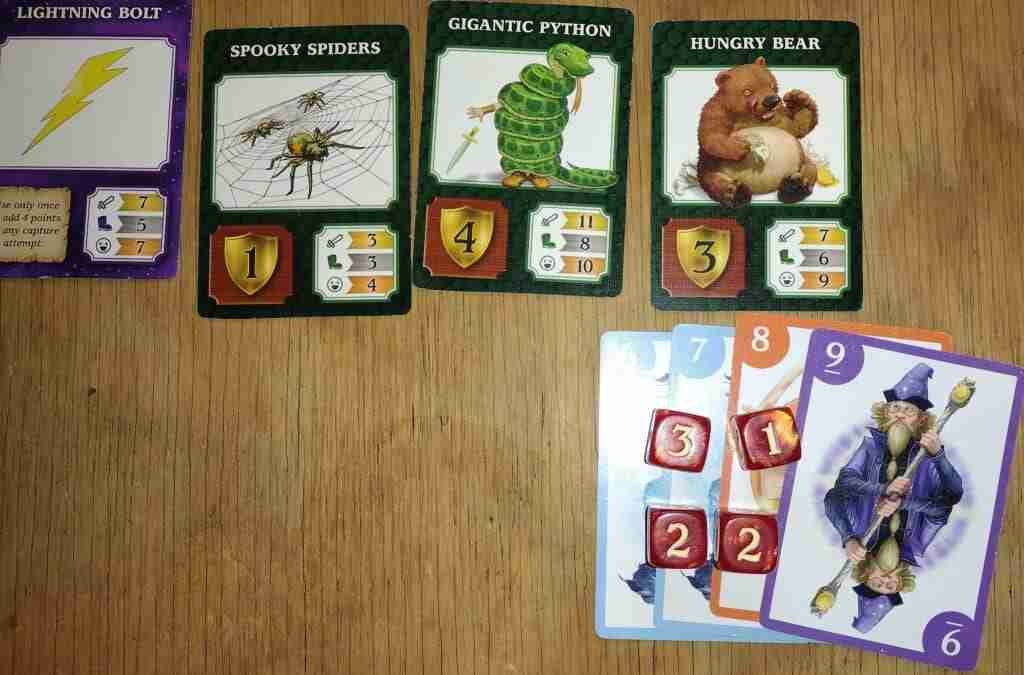
A stomp attack needs all the cards you use to be of the same number. This one is definitely the hardest to get, but often, the best attack. Since there are only five suits (colors), you’re limited to a maximum attack of five dice (without enhancements). Whether the cards are high or low in number has no impact on the attack.
Stomping on the Spooky Spiders. Two cards of the same number mean you roll two dice. A total of 4 beats the spider’s 3 necessary for the stomp, so you get to keep the Spooky Spiders (they’re worth 1 point).
A scream attack means that all the cards are of the same color (suit). This one is often the easiest to accomplish. It doesn’t matter what the numbers are.
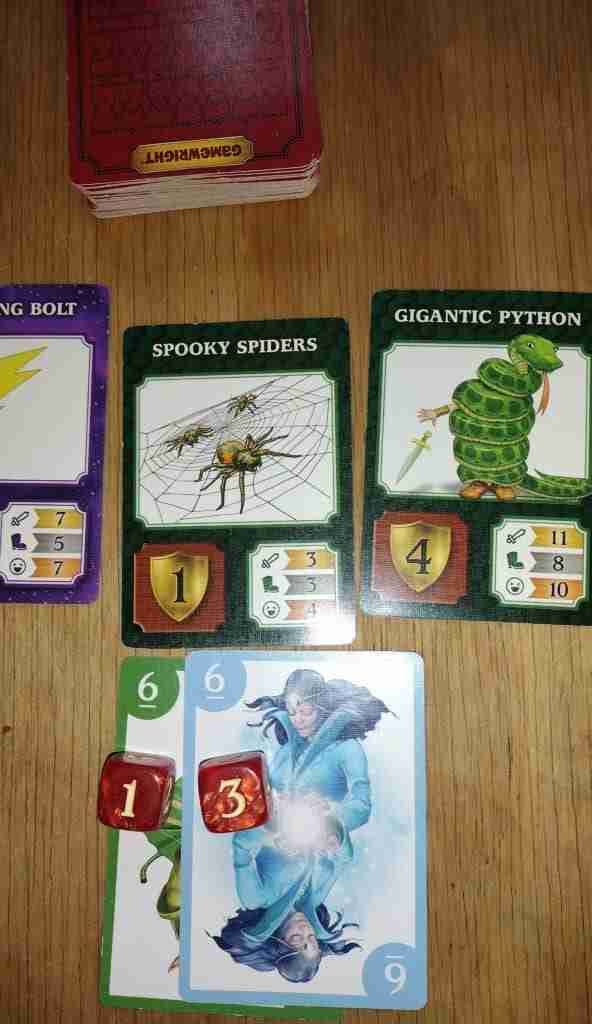
Screaming at the Gigantic Python. Four cards of the same color mean you can roll four dice.
Once you have your attack formulated, you pick up the same number of dice as cards you used in your attack. Dice are numbered 1-4, with two 2s and two 3s. Roll the dice and add them up. If the total is greater than or equal to the number on the card for the corresponding attack, then you capture the creature or enhancement.
Enhancements can help you capture creatures
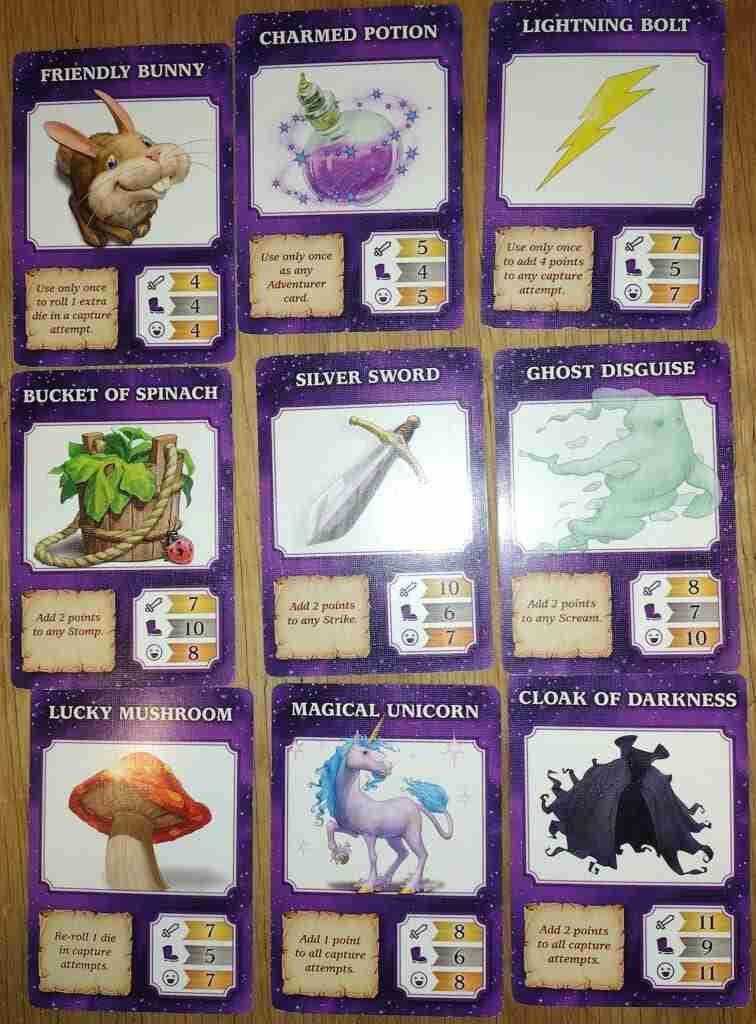
Enhancements go in front of you, to be used in helping you capture a creature. Some enhancements are one-time-use, while others can be used over and over again. Some help with any attack, while some are specific to one type of attack.
These are all the enhancements in the game. The top row are only used once, the middle row are only for specific attacks, and the bottom row are good for all attacks.
Dragonwood is a combination of luck and strategy, with addition thrown in for good measure. Sometimes you’re not able to draw much of anything in a hand. With a hand limit of 9 cards and 5 suits in the game, you could get no more than a 2-card scream. You might not get more than a 1-card stomp, or a 2-card strike. But it’s also possible to get a 6-card scream or strike, or a 5-card stomp.
Strategy in Dragonwood
The strategy comes in deciding what you go after. Do you get all the easy cards that are only worth 1 point? Do you focus on the high-value cards? Do you try to get enhancements, that aren’t worth any points but might help you capture creatures? We’ve played games where someone worked hard to get an enhancement, only to never use it. Sometimes, enhancements show up at the end of the game, making them less useful.
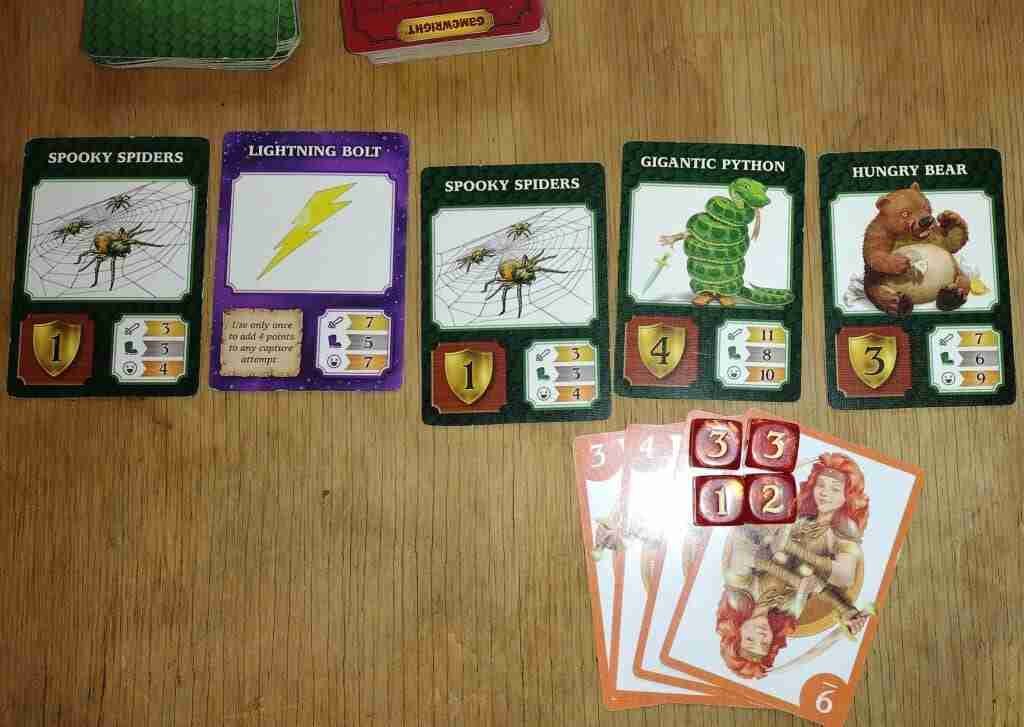
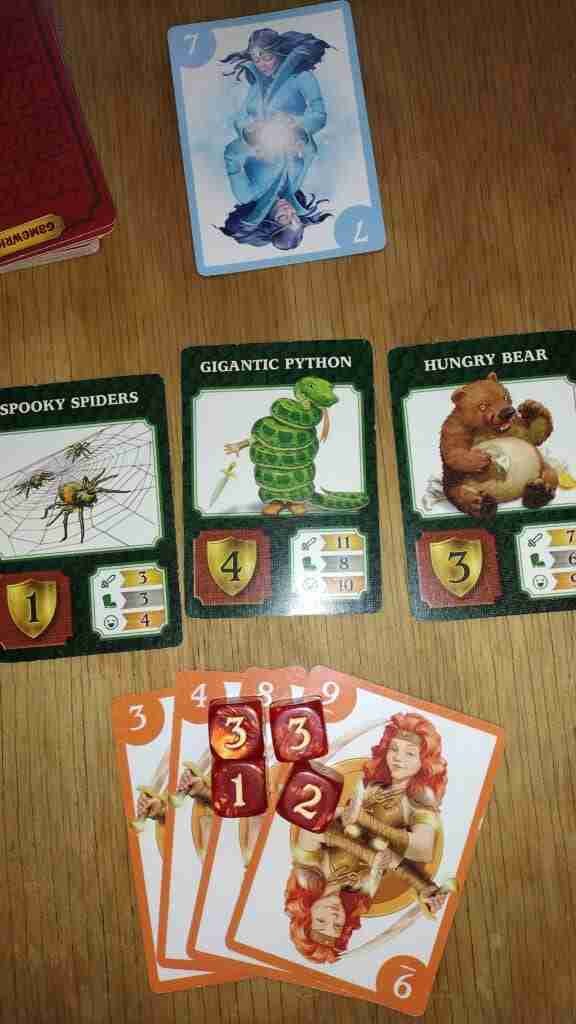
If you formulate your attack, roll the dice, add up the numbers, and they don’t at least meet the corresponding number on the card you’re trying to get, you have to discard one adventurer card as a wound. It doesn’t have to be a card from your attack, meaning you can save that attack for later and discard a different card from your hand, but it is a wasted turn that just leaves you with one less card.
In this scream attack against the Gigantic Python, rolling a 1, two 3s, and a 2 is not enough to beat the python’s 10 against scream. So, the card above is discarded, and this attack is saved for later.
Dragonwood is great for risk-assessment practice
In this way, Dragonwood is great for risk assessment. My kids periodically try to go for high-value cards with very low attacks. I have to ask them, “How likely are you to get 8 points with just 2 dice?” Sometimes, they try for an attack that’s not even possible (need to get 9 or even 10 points but only use 2 dice). If they’re obviously ahead, I’ll probably let them learn their lesson the hard way and ask my question after they have to give up a card. But if they’re struggling (or usually, no one is obviously ahead or behind), I’ll ask them before they roll the dice and let them change their mind.
There is a sequel that we haven’t tried yet. DragonRealm is supposed to be just as good as Dragonwood, but I think it focuses on multiplication. If you’ve tried it, please let me know what you think!