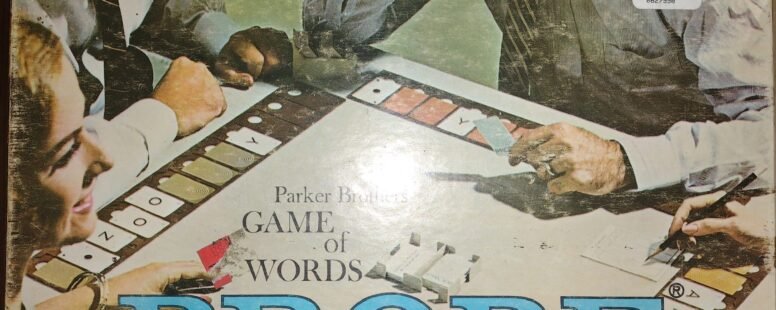
I love finding old games at the thrift store. Sometimes they’re no good, often they’re great, but the price is always fantastic! Probe fell into the category of “great” old games. Probe can be played with 2-4 players, and as long as your kids are at least okay spellers, it’s great to play with them.
Each player gets their own card rack with 12 slots and a deck of 96 letter cards: 5 “blanks” (just a dot in the middle of the card) and the rest with letters. There is also a small “activity deck” of 48 small cards that each contain an action. There’s even a tiny tray for them!
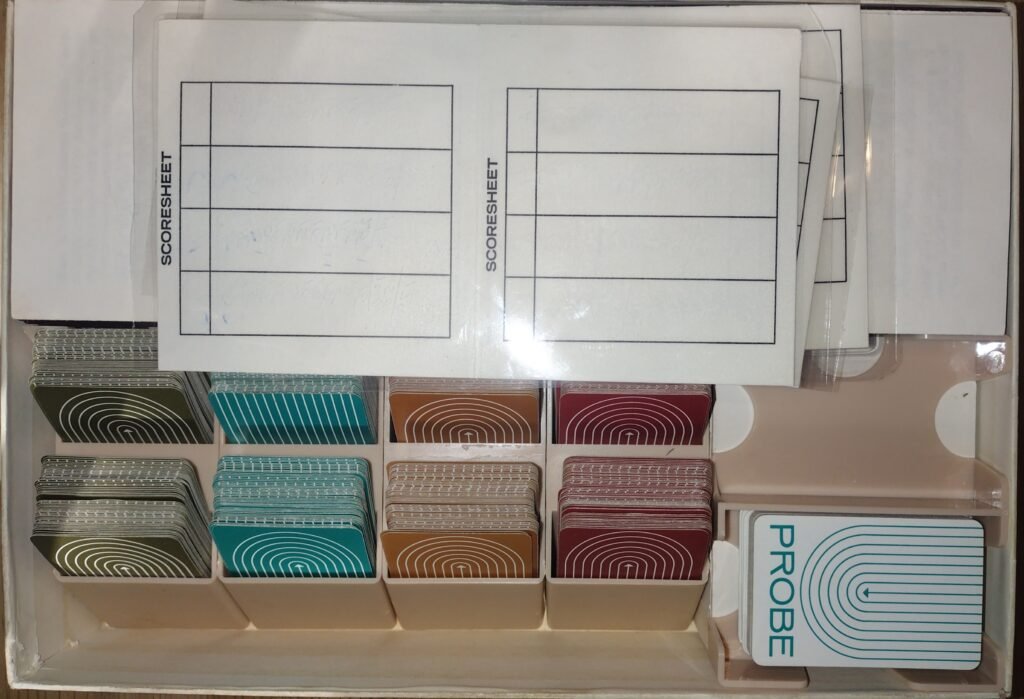
Probe’s box is not huge, but there is some wasted space. However, everything is so cleverly arranged and stays neat, so we didn’t unbox it.
How to Play Probe

To begin, each player chooses a word they want to use and figures out how to spell it. Dictionaries can be utilized at this time, but not later in the game. Each player finds the letters they need to spell their word and arranges the cards so other players will be able to see them. That is, create the word from right to left. However, keep the cards face-down.
Each player has five blank cards that players may use if they wish at the beginning or end of their word. However, they cannot put blanks between any letters. Theoretically, the blanks can help disguise how many letters are in your word, but they’re so easy to guess that they might not be worth it.
Playing a Turn
On your turn, draw an activity card and follow its instructions. You may be instructed to reveal a card, take a normal turn, or take an extra turn. One of your opponents might have to reveal one of their cards. Then, ask one player if they have a letter (or blank). If they do, they have to reveal it, but if they have multiple, they only reveal one.
As long as you guess correctly and your opponents have to reveal cards, keep asking. However, as soon as one player does not have a card you asked about, your turn is over. Points are scored based on the point value on the card rack for every card someone has to reveal due to your questions. Activity cards do not score points, unless they directly say to adjust your score.
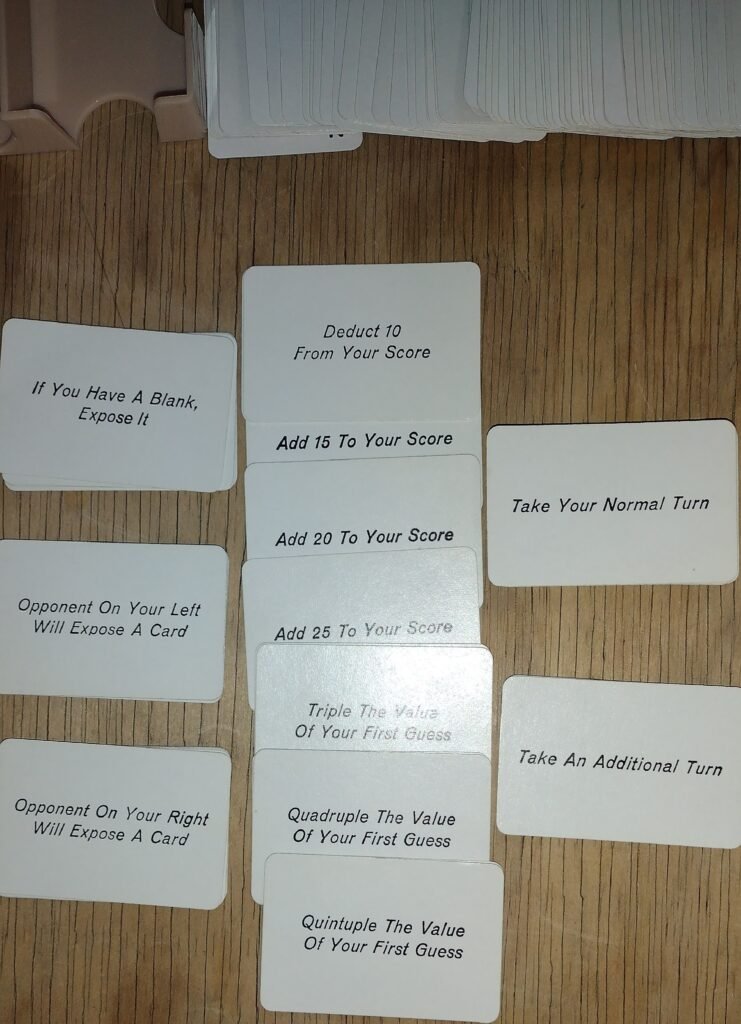
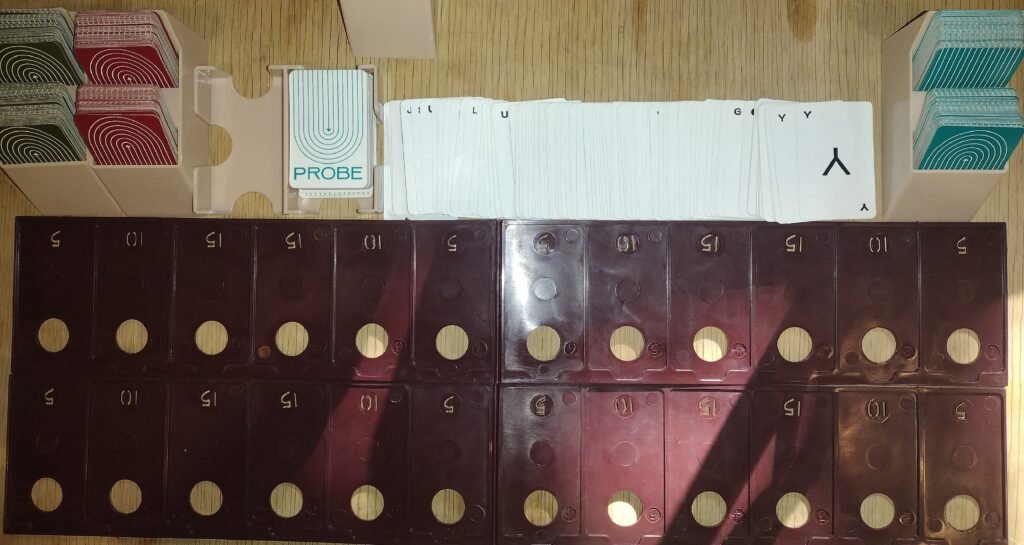
For example, on my turn, I draw my activity card. It says for the player on my right to reveal one card. They do, a blank, but no points are scored. I ask if my opponent on my left has any blanks. They do, so they turn over their first card. This slot is only worth five points, so I score five points. I ask if the player on my right has any more blanks, but they don’t. My turn is over and I only scored five points.
Learning Within Probe
If your family plays a fair number of word games, your kids will start to realize that different letters occur with different frequencies. Three of the most commonly used letters are E, S, and T, so these are great first letters to guess. This will encourage your kids to think about probability, and they’ll stop asking if you have any J’s, Q’s, or X’s.

And of course, Probe is full of spelling and addition practice. However, the spelling practice in Probe is particularly excellent. You start with all unknowns and slowly reveal more cards. You want to score more points, which requires asking more questions and getting the answers correct. So you’re thinking the whole time about what words your opponents could have. You’re having to spell words, count letters, AND keep track of what letters have been asked. You’re not allowed to write anything down. So this means you’re building working memory skills, too.
Overall, Probe is an excellent addition to our spelling and word games. If I only wanted one game or was especially short on space, it wouldn’t be my choice (Bananagrams and Quiddler are both smaller games). However, I love it as an addition to our library.