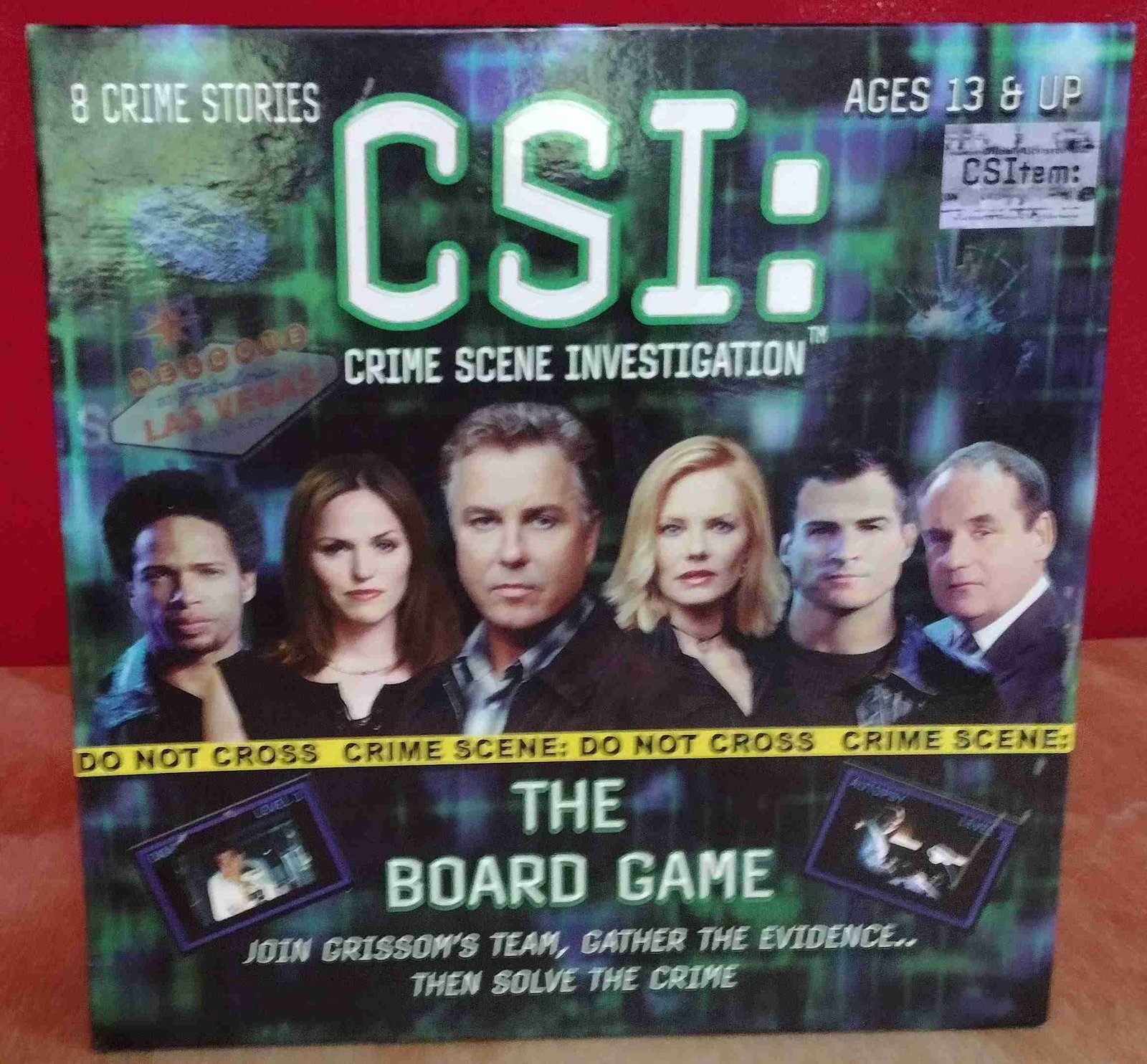
If you love whodunits like Clue and crime shows as much as I do, then this CSI board game might be just the thing to round out your collection. With a bit of modification, I do think this can be a great game that’s lots of fun!
This post may contain affiliate links, meaning if you click on it and make a purchase I’ll receive a small commission at no cost to you. As an Amazon Associate, I earn from qualifying purchases. For more information, please check our Privacy Policy and Disclaimers and Disclosures.
The CSI board game is a bit like Clue, but especially for lovers of the TV show. Personally, my favorite CSI version is Miami; I just love how Horatio is everyone’s father figure and looks out for them, whether they’re one of his employees, a victim, or even a suspect. (I have since found out that there’s also a Miami version of the game, so if you, too, prefer Horatio to Grissom, then maybe look for that version. Although, the two games don’t look much alike; now I’m curious to try the Miami version and see if it’s better.)
The CSI board game is competitive rather than cooperative
In Clue, it makes sense that it’s a competitive game, as one of the participants is the murderer. But in CSI, all the members of the team are working together to solve a crime that none of them are involved in (in fact, if someone is considered too close to a case, they’re removed from the case and can’t help; it’s a conflict of interest). So it really doesn’t make sense to have CSI be a competitive game, and it made it unduly long.
That was another thing – the pace of the game was terrible. We decided this game must not have been playtested much, if at all; even my husband and I lost interest by the time we’d finished the level 1 cards. As a group, we decided to abandon gameplay and just read all the cards, and figure out who did it. Even this way, it still took us over an hour to play the game; it would have taken us hours to play entirely by the rules.
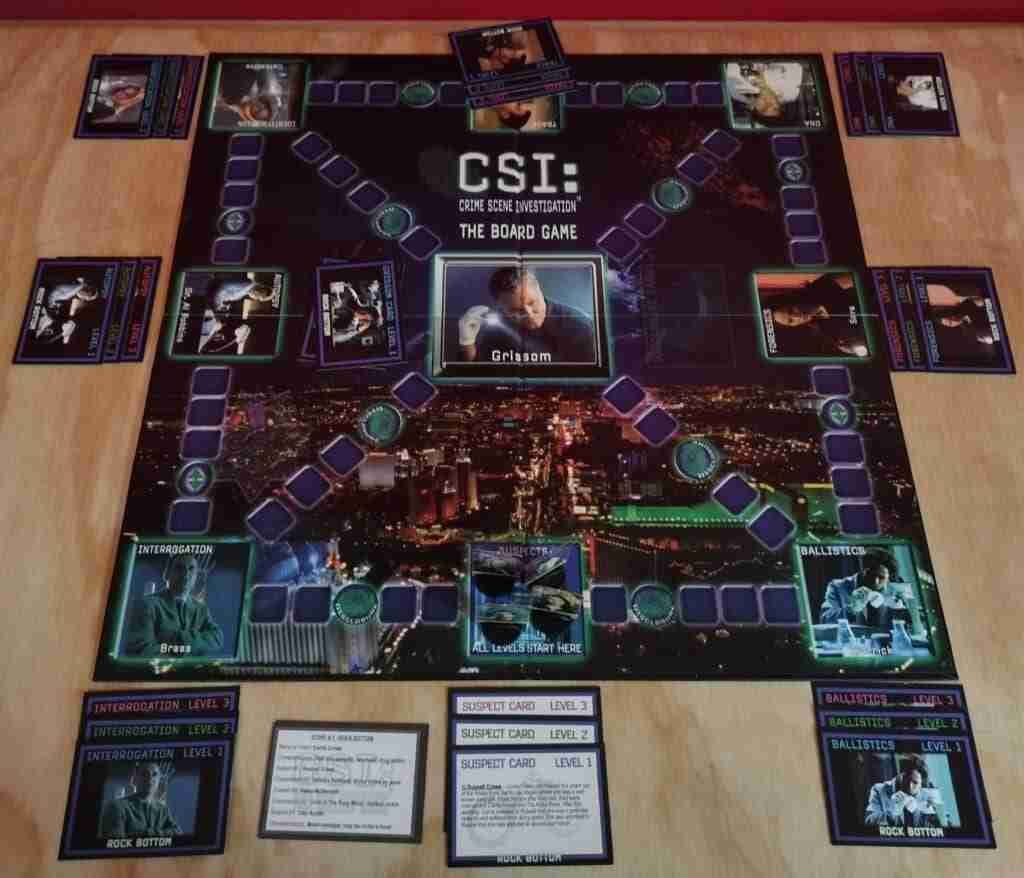
Our recommended modifications to the CSI board game
Even though it explicitly says, in at least two spots, that you need an exact roll to land on any of the spaces, and also that you can’t change direction mid-turn, this, too, makes the game needlessly long. It would be much better if you could use whatever shenanigans you needed to land on the spot you needed to get to, whether that’s backtracking mid-turn, or stopping your move early because you rolled higher than you needed.
There were also some Disclosure Cards that really made the game even more antagonistic than it was already – several cards allowed you to block another player from entering one of the lab rooms, or Grissom’s office. While we do play competitive games as a family, and enjoy them, we try not to make them excessively cutthroat.
Game board optional
After getting the CSI board game, I saw some instructions on Board Game Geek to throw out the game board entirely, and just play the game as a card game. However, before going to this extreme of a route, I think we’ll try to keep the board game, but let you use any of the previously mentioned shenanigans to get to where you need to be. Also, we can make it cooperative by just reading evidence cards out loud, and then leaving them face-up for everyone.
Another thing! You choose which of the 8 characters you are, and each of these different characters has a role in the show, they have a spot on the board, and they even have a blurb about each of the “personnel.” But it’s all just flavor text and has no gameplay component. If you’re the individual who works in Trace, and you land on Trace, you should get some sort of benefit – maybe looking at all three Trace cards. Or at the very least, draw a Disclosure card (though I think we’ll need to remove all the Disclosure cards that aren’t helpful).
I have mixed feelings about clue levels
There is an additional component to the gameplay that I’m not sure about. There are 3 levels of clues for each of the 8 locations, and you can’t get to level 2 clues until you get ALL of level 1 clues, and you can’t read any level 3 clues until you get all of the level 2 clues. Now, on the one hand, this does make the game extra long and complex, so part of me says you should just be able to read all three clues the first time you get to a location. However, some of the level 2 cards reference a level 1 card from a different location, and things are sent from trace to DNA, for example, so it sort of seemed to make sense. We’ll need some more gameplays to figure out how to best play this game.
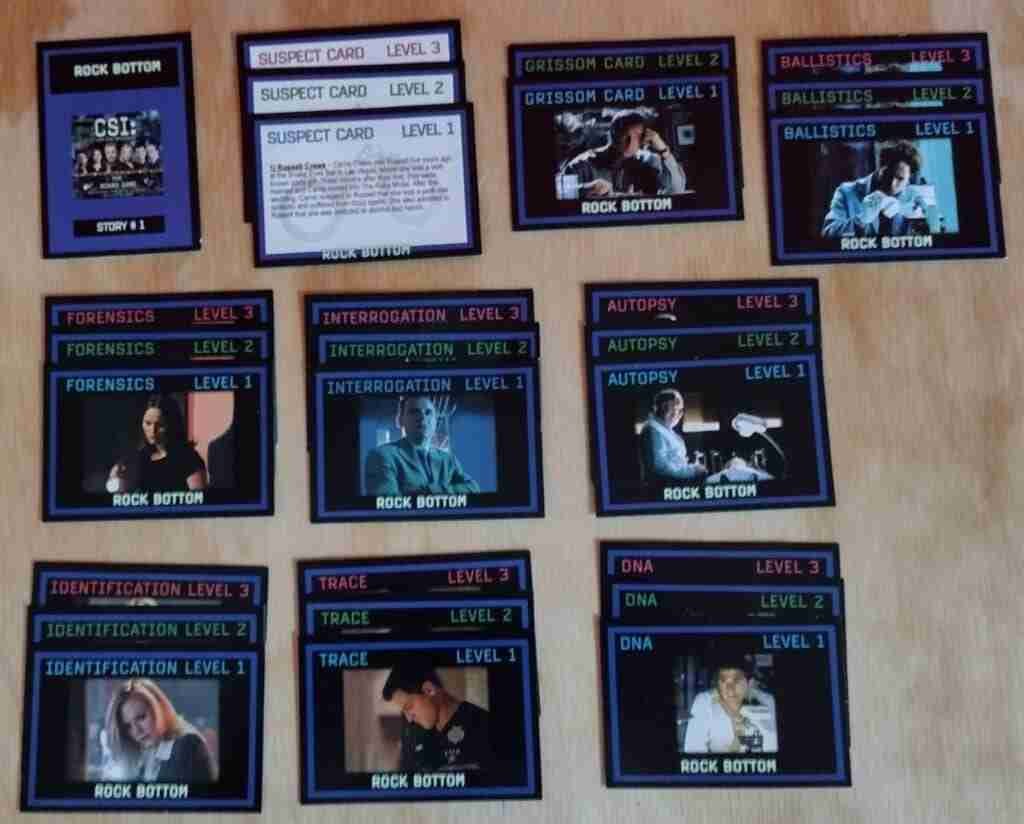
This brings me to another point against this game – there are only 8 crimes!! And really, once you know the solution, no replayability at all. By the time we figure out the best way to play the game, we’ll be just about done with it and ready to pass it along to another family. But, we do like our crime scene shows and games like Clue (at least, me, my husband, and our son does; our daughter doesn’t really have the attention span for them yet). I think we will probably keep this game to play through all 8 scenarios, and of course, update you here on the best way to modify the rules so that you can have a more ideal gaming experience.
Play-tested modifications
We played through the second story and settled on the following modifications:
- Antagonistic Disclosure Cards removed
- Cooperative gameplay. This made several of the Disclosure Cards redundant, but we left them anyway.
- Use a d12 (12-sided die) instead of the provided d6. Even with cooperative play, the game is just too slow with the d6, as you don’t often roll a 6. Using the d12, we were able to get to different labs much more quickly.
- Use whatever shenanigans you need to get to the lab you’re going for. Generally, this means stopping your move before you’re out of moves. This just makes more sense and makes the gameplay more realistic.
One thing we thought about, but didn’t end up doing, is giving a bonus whenever a player landed on their own lab. It still made the most sense to read each level of clues as a level (so we didn’t read any level 2 clues until all level 1 clues were read). Many times, a piece of evidence discovered in one lab in level 1 will be examined in level 2 in a different lab.
Expansion packs might be an improvement
There are expansion packs you can buy. We haven’t tried them yet, and I’m not sure if we will, but from other reviews I’ve read, they seem to be a bit better. But I would say that the CSI board game isn’t worth its retail price. If you can find it really cheap at your thrift store, or better yet, free, then it’s probably worth it, at least to play with modified rules. If you’re still unsure, watch our play-through with our modified rules.